‘We cannot imagine how we used to live without it.’ How teenagers are counselled on career choices in Avanhard community
Avanhard community is situated in the immediate vicinity of Odesa. Due to this proximity, local school leavers often choose the obvious path – to go to the regional centre to study or look for work.
However, the growth of local businesses and their need for staff had gone unnoticed by young people. As they drive past large logistics centres, manufacturing plants or small businesses, schoolchildren rarely consider that a successful career with a competitive salary can be built right on their doorstep.
To change this situation, a career guidance system was introduced within the framework of DECIDE Project. In Avanhard, instead of simply holding a few lectures, a large-scale initiative was launched, prompting not only teenagers but also their parents to rethink their approaches to choosing a profession.
When everyone does career guidance – nobody does it
The community admits that, until recently, introducing young people to the world of professions resembled a chaotic advertising campaign.
‘Each educational institution held isolated events. These were profession days and self-organisation days, which are practised throughout almost the whole of Ukraine. Representatives from universities came with information materials and talked about their fields of study. However, it looked more like an advertisement for their services. Career guidance was conducted so superficially and in such a fragmented manner that it did not stick in the students' minds and did not reach their parents. We simply did not see the value in it,’ admits Aliona Syritka, Legal Advisor to the Education Department and the community’s career coordinator.
There was also no common strategy or specialists responsible for careers guidance in the community.
‘When we began piloting the career guidance system and conducted our first survey, it became clear to us that, up until that point, we had not fully understood what this system should actually look like. The project highlighted the value of this approach as a key element in the transition to specialised education within the framework of the New Ukrainian School reform. By Grade 9, students should have a clear understanding of their future educational pathway. And it is very important for us to see the results next year, when the first cohort of Grade 9 students under the New Ukrainian School programme graduate,’ says Iryna Solotynska, Head of the Department of Education, Culture, Youth and Sport at the Avanhard Settlement Council.
Understanding this path protects teenagers from making chaotic decisions in the future, when years of study are wasted due to a lack of information.
‘At the end of the academic year, during a forum on our career guidance practices, I heard something important from the directors of the pilot institutions, “We cannot imagine how we used to work without this.” Now there is a clear goal. It is very painful when a child has no idea what they want and simply goes on to senior school out of habit, stays there until Grade 12, and only realises at the end that they have no idea why they were doing it in the first place. In that case, they end up returning to vocational education anyway, but time and resources have already been wasted, and everyone is left dissatisfied,’ says Aliona Syritka.
How it all began
Firstly, the career counsellors and the career coordinator underwent training provided by DECIDE. Next, excursions to local businesses were organised so that the children could see a variety of professions from the inside and get a real feel for them. To achieve this, the organisers decided to approach the tax and revenue department of the settlement council to identify the largest taxpayers and the businesses that create the most jobs in the community. The aim was to demonstrate the scale of local business. In total, the community organised 23 excursions for students in Grades 8 and 9 over the course of several months.
‘Epicentre unexpectedly turned out to be our most welcoming partner. For nearly three months, every Tuesday, they were ready to welcome our children, as we had many groups due to the high number of students in the schools. They were the first to invite us and explained to the teenagers that they offer summer work placements for 14–16-year-olds under different conditions, with variable hours and pay rates. When negotiating with businesses, it is important to clearly define the topics of discussion, as companies usually just want to show how good they are, while children are interested in specific figures. We asked them to state the salary range every time, and this gave the students a clear idea,’ notes Aliona Syritka.

At Epicentre
For teenagers, this approach provided an opportunity to feel like adults. Visits to large retail centres broke down the barrier of formality.
‘I often went to Epicentre with my parents to do the shopping, but it turns out there are far more professions there. At our age, 14–15, we can already work and earn our own money. The specialists gave really interesting talks about their professions; they didn’t treat us like little children who just needed to be entertained, but seriously described the pros and cons of their jobs. It really helps us choose our future path,’ says Sofiia Savytska, a ninth-grade student.
One of the most eye-opening experiences for the students was a visit to the Krioprom company, which specialises in technical gases and oxygen equipment. Modern industrial production completely transformed the teenagers’ perceptions of engineering professions.
‘When the eighth-graders were told that a single unit manufactured by this relatively small company costs USD 5 million, it came as a shock to them. They started asking lots of questions about where such funds go. The structure was explained to them: procurement, wages, management. The boys, who had planned to go to a vocational college after finishing Grade 9, saw the engineering profession in a completely different light. They realised that a technical field does not necessarily mean building houses, and became even more interested in this sector,’ says Tetiana Sholoiko, Deputy Director for Educational Work at the Avanhard Lyceum and career counsellor.
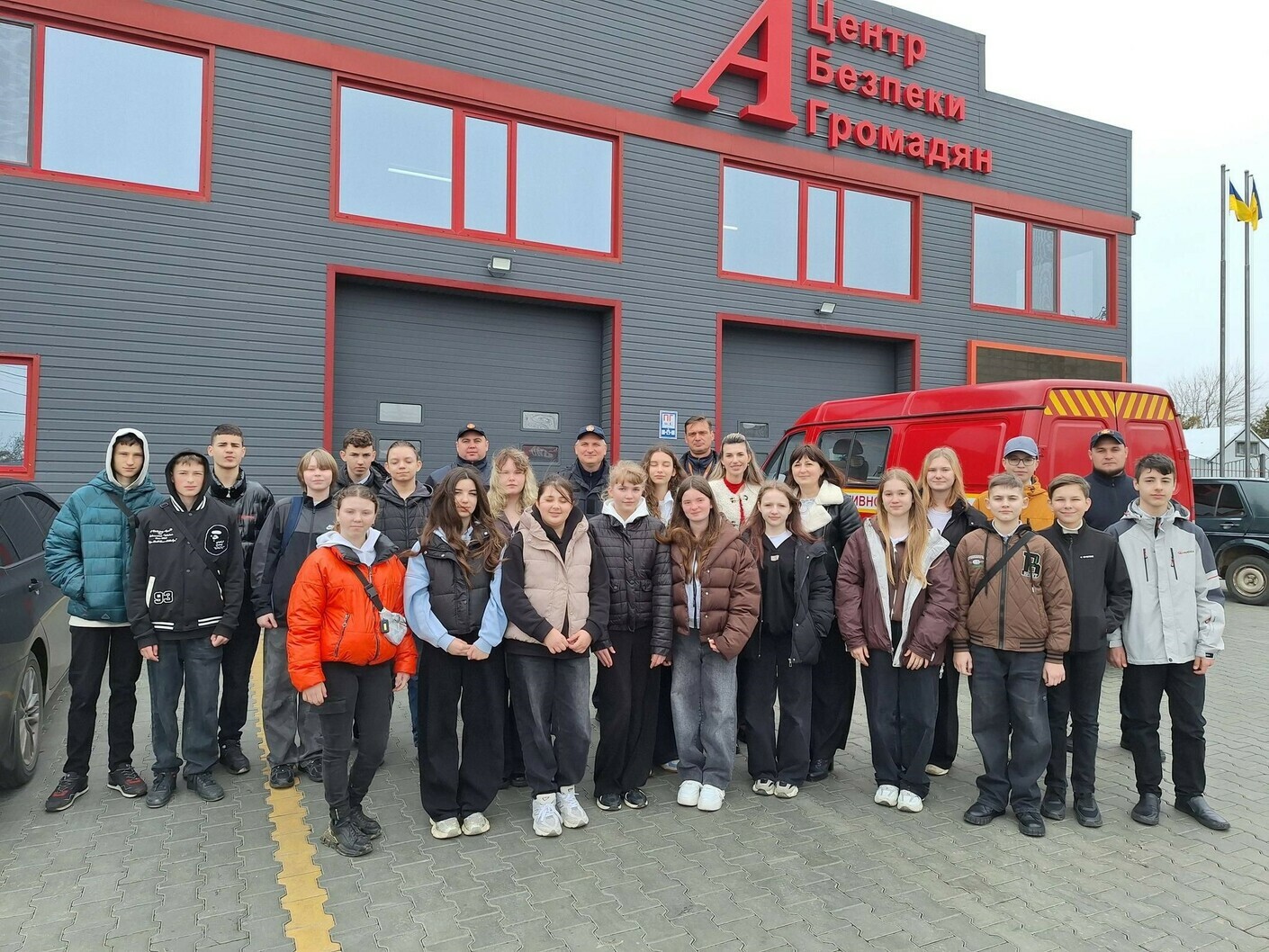
The careers coordinator carefully selected the organisations to visit in order to show the teenagers the diversity of the labour market. The schoolchildren visited the newly built Public Safety Centre, where the more daring among them tried sliding down a fire pole and learnt that a rescue team includes a safety engineer, accountants and lawyers.

At the Public Safety Centre
During an excursion to the mayor's office, the students saw how finance officers, HR staff and accountants worked, and realised that running a community is a team effort.

At the Avanhard Settlement Council
‘At every company, we focused on demand. Although our community’s main economic sectors are trade and logistics, the greatest shortage of staff is in blue-collar professions. These include fitters, turners, machine operators, electricians, and drivers. We asked them to compare the terms and conditions. For example, a starting salary for lawyers or economists in an office starts at UAH 20,000. Whereas at the large transport company Multitrans, drivers are given two sets of work clothes, provided with meals at the workplace and receive higher pay. The comparison of earnings often surprised the children,’ explains Aliona Syritka.
Such details helped many senior students to take a fresh look at their future career paths. Law and maritime studies remain popular among school leavers, but this practical experience enabled them to broaden their understanding of the modern labour market, discover new professions, and see the prospects for building a career in their own community.

During a visit to Multitrans Ltd
‘One boy came up to me after the excursion and asked, in surprise, whether a lawyer really could work anywhere. He thought that lawyers were only solicitors, notaries, or representatives in court, and was unaware that they could work for transport companies or the settlement council. He asked whether there was any point in him studying law. I replied that I could not decide for him, but as a lawyer working in the local government, I could honestly explain the strengths and weaknesses of this profession. If he wants to be a prosecutor, we will try to organise an excursion to the public prosecutor’s office,’ adds Aliona Syritka.
When logistical or safety restrictions prevented children from visiting production facilities in person, the organisers switched to an online format, which also provided plenty of insights.
‘We really wanted to go on an excursion to “Aptena nyzkykh tsin” (Low-Price Pharmacy), but their premises are too small to accommodate a large group of children. Then the company suggested moving the excursion online. They independently connected a college that trains specialists to the meeting and clearly illustrated the entire pathway for the schoolchildren: from vocational education to the actual workplace. For those teenagers interested in medicine and pharmacy, this was incredibly useful,’ recalls Aliona Syritka.
The students found the virtual introduction to global brands and the complexities of large-scale food technology just as exciting.
‘The impressions from the online meeting with “Coca-Cola” were very positive. The students did not know exactly what this drink is made of, but on the screen they were shown the entire chemical reaction – how regular sugar is transformed into the brand’s signature colouring. The company’s wide range of products, such as diet drinks, was also a revelation. It was amazing,’ says Tetiana Sholoiko.
Psychology of auto mechanics and revival of sewing production
Open discussions with business owners played a key role in the career guidance process. It was important for the schoolchildren to see that behind large companies are ordinary people who have also made mistakes along the way. One of the most successful examples was a visit to a local car repair workshop. Its owner had originally studied to become a teacher under pressure from his parents, who wanted him to have a stable job, but eventually turned his hobby into a profitable business.
‘The owner of the service station turned out to be a very interesting person; he approached the matter from a psychological perspective. He suggested bringing my own car in, hoisted it onto the equipment for a demonstration, and serviced it free of charge. And then he let the children rummage through a drawer full of spare parts and take them home as souvenirs. He used his own experience to explain how he went from being a car mechanic to a business owner. When teenagers see this kind of down-to-earth approach, they realise that businesses are run by ordinary, friendly people from whom they can learn from scratch,’ says Aliona Syritka.
For the schoolchildren themselves, these real-life stories became the key factor in overcoming their fear of the choices they will face in the future.
‘When business owners talk about their career path and mention who supported them and who didn’t, it’s really important. I’m very anxious myself about what to study; I’m afraid of choosing the wrong profession or that I won’t succeed. But when you hear an expert who has also made mistakes and didn’t get everything right the first time, you start to realise that you’re just like them and that you, too, can succeed,’ says Sofiia Savytska.
No less moving was the excursion to the Kozakov family’s small-scale sewing business in Prylymanske. When the community’s careers coordinator first rang the owners, they admitted that, due to the difficult economic situation and an acute shortage of pattern-cutters, who had moved abroad, they were planning to downsize.

During the excursion to the sewing production facility
‘I started trying to persuade them, saying, “Let’s organise an excursion, show the children around, take some photos, and promote it on social media – who knows, maybe that will bring you some new customers?” The schoolchildren went there, were given a very warm welcome, sat down at the sewing machines, and were shown how to cut, sew and apply rhinestones. The owners spoke honestly about the challenges in this field and about the versatility of a pattern-cutter’s skills, which can help one find work anywhere in the world. The children left with their eyes shining, and we spread the word about them as widely as possible; we hope this will help keep the business afloat,’ says Aliona Syritka.

During the excursion to the sewing production facility
Breaking down stereotypes and first lessons
An important part of careers guidance has been the shift in parents’ attitudes to vocational education. For a long time, there was a widespread stereotype in society that attending a vocational college was not a prestigious option. However, the actual shortage of skilled workers and the level of wages have forced adults to reconsider their views.
‘Parents are eager to send their children on excursions, as it is a chance to take a break from gadgets and see production facilities with their own eyes. Even if a child initially did not want to go, their parents persuaded them to try it. After the first visit, the children became keen to find out what goes on at other companies. In future, we plan to make working with parents a major focus, so that they do not impose their own unfulfilled dreams on their children, but help them discover their children’s strengths,’ emphasises Tetiana Sholoiko.
During these visits, the teenagers immediately turned into sources of new information for their families, shattering the adults’ outdated perceptions of the labour market.
‘Our parents, just like us, know very little about certain professions. When you visit a company in person, you start to understand everything better, and then, back at home, you tell your parents what actually goes on in a particular sector. They start to get involved, asking about how we feel and finding out interesting things. It’s such an important shared bond,’ adds Sofiia Savytska.

During the excursion to Production and Residential Public Utility Company
These findings are also supported by the statistical data the community collected during the final monitoring.
‘According to the results of the latest survey, parents’ ratings of the excursions and lessons organised were even slightly higher than those of the schoolchildren themselves. The first survey revealed scepticism and low engagement among parents; they were only aware that representatives from universities were visiting. Now everyone is talking about it. Adults are beginning to understand the prestige of blue-collar professions; they can see the demand and the realistic starting salaries of UAH 40,000–60,000. They realise that their child can secure a simple and sought-after job that will not be replaced by AI in the near future, and then go on to develop their own business,’ says Aliona Syritka.

At Multitrans Ltd
In parallel with the excursions, JOBS lessons were held at the lyceum. Due to the limited number of hours, the teachers managed to cover three core topics: what a profession is, an introduction to different specialities, and the professions of the future. Game-based teaching methods were used during the lessons, in particular the “chair presentation” format using randomised cards. The students enjoyed the format, so from next year this course will become part of the curriculum.
Strategic community decisions and the school “series”
The implementation of the new system demanded considerable effort from the management team. However, the community now has a clear action plan for the future and is mobilising its own resources to develop the initiative.
‘We have taken a strategic decision: we allocate funding from the local budget and, from September, will introduce the role of career counsellors in all four educational institutions in the community. Two non-pilot institutions have also taken a keen interest in the process and wish to introduce this role. In next year’s plan, we have stipulated that from November to March, each school must organise at least 15 excursions. We will only see the full results and statistical data in a few years’ time, but the project has already highlighted employment opportunities in the community that even adults were previously unaware of,’ notes Aliona Syritka.
Avanhard’s experience has already become a model for other regions. Recently, a sister community that came on a working visit was introduced specifically to the career guidance case study, as the council leadership sees this as a tool for balancing the education system and aligning it with the needs of the labour market.
Students themselves engaged in the process to such an extent that the student council launched its own media project. The teenagers decided to create a series about different professions, with each episode exploring the details of a specific specialty. They devised the interview questions themselves and filmed the first two episodes – about the school director's daily work and the duties of a laboratory assistant in the chemistry lab. They plan to continue the video series from September.
‘This project helps to establish an effective partnership between the community, business, and education by involving parents. Our school video series has unexpectedly sparked interest among adults; they have started actively watching the videos and giving them “likes”. One father even rang us and admitted, somewhat surprised, “I thought a lab assistant just wiped the dust off things in the lab.” Such heartfelt feedback proves that careers guidance benefits the whole community, helping both adults and children to better understand the modern world of work,’ concludes Tetiana Sholoiko.
The national pilot project for a career guidance system for children and young people in communities and regions is implemented by the Swiss-Ukrainian DECIDE Project, which is carried out by NGO DOCCU and the Zurich University of Teacher Education – International, with the support of the Embassy of Switzerland in Ukraine, in partnership with the Ministry of Education and Science of Ukraine and the Ministry for Communities, Territories and Internally Displaced Persons of Ukraine.
Mariia Buleiko (Markovska)
Tags:
war education education vocational training college DECIDE: PROFTECH
Область:
Одеська областьГромади:
Авангардівська територіальна громадаSource:
Проєкт DECIDE
15 October 2026
‘My community and my country value me.’ How...
In Zymne community in Volyn region, career guidance is no longer just a formality. Here, students are not...
22 September 2026
Live in the city, not struggle to get through...
Barrier-free urban spaces begin with specific solutions that give people greater independence in their daily lives....
17 September 2026
Barrier-free beach in Odesa: How accessibility changes seaside holidays
Barrier-free beach in Odesa: How accessibility...
The Decentralisation portal is launching a series of articles on community initiatives that make public spaces and...
15 September 2026
Career guidance unites. How evacuated...
The community is located in an area of active hostilities; its residents have been fully evacuated and are now...