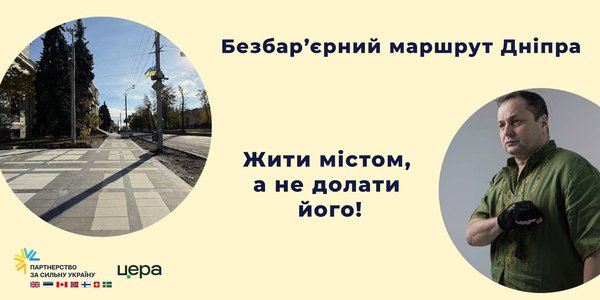
Live in the city, not struggle to get through it. How a barrier-free route in Dnipro changes daily travel for people with disabilities
Barrier-free urban spaces begin with specific solutions that give people greater independence in their daily lives. Dnipro’s experience shows how changes to pedestrian and transport infrastructure can be combined along a single route to make getting around the city more accessible for people with different needs. We report on the solutions that are already implemented in the community and how they are changing residents’ daily experiences.
A city’s accessibility is not determined solely by whether one can enter a building or walk along a pavement without hindrance. It is equally important whether a person is able to use public transport independently and reach their destination.
For Almas Khaziiev, a veteran of the 93rd Mechanised Brigade “Kholodnyi Yar”, this issue is one he knows all too well from personal experience. Almas, aged 62, has had both legs amputated and works at the Mechnikov Dnipro Regional Clinical Hospital, where he is involved in the psychological rehabilitation of wounded soldiers.
Before the barrier-free route was installed, getting around the city was much more difficult for him. There were no tactile paving tiles or special kerbs at the tram stops, and boarding the tram meant having to climb high steps.
‘You had to climb quite high to get onto the tram; it was difficult,’ recalls Almas.
This experience is relevant for other veterans too. Oleksandr Teplov, aged 22, says that for people who are just starting their rehabilitation and learning to walk on prosthetic limbs, steep steps can be particularly difficult. In some cases, transport staff can offer assistance. However, in Oleksandr’s view, these measures are not enough to ensure systematic accessibility.
‘Staff can do their best to make the journey more comfortable. But accessibility should not depend on human assistance – it must be built into the environment itself,’ he explains.
The redevelopment of Route No. 1 in Dnipro is aimed directly at removing such barriers. It has been identified as a priority for work due to its central location, high traffic volume and proximity to key elements of the city’s infrastructure.
The changes cover both the pedestrian and transport sections of the route. Here, pavements, kerbs and pedestrian areas are undergoing renovation, whilst at tram stops, raised boarding platforms, roofs and spaces for wheelchair users are installed.
At the same time, the tram infrastructure has been modernised: tracks, level crossings, the catenary system and supports have been repaired at the junction of Yavornytskyi Avenue with Korolenko and Monomakh Streets. Once this work was completed, low-floor trams were brought into service on the route.
The development of Route No. 1 is just part of a larger-scale effort to adapt the urban environment. Ksenia Donetska, Head of the Architecture Sector in the Main Department of Urban Planning and Architecture, explains that this involves a comprehensive rethinking of the city’s infrastructure in line with the principles of accessibility.
The project “Enhancing the Accessibility of Public Services and Communication in Communities” is implemented by CERR with the support of the “Partnership Fund for a Resilient Ukraine”, which is funded by the governments of the United Kingdom, Estonia, Canada, Norway, Finland, Switzerland and Sweden.
Tags:
Область:
Дніпропетровська областьГромади:
Дніпровська територіальна громадаSource:
Радниця – Уповноважена Президента України з питань безбар’єрності
17 September 2026
Barrier-free beach in Odesa: How accessibility changes seaside holidays
Barrier-free beach in Odesa: How accessibility...
The Decentralisation portal is launching a series of articles on community initiatives that make public spaces and...
15 September 2026
Career guidance unites. How evacuated...
The community is located in an area of active hostilities; its residents have been fully evacuated and are now...
10 September 2026
«Де народився, там і згодився». Як...
Проблема відтоку молоді за кордон для Керецьківської громади, що на Закарпатті, історично є гострою, адже регіон –...
10 September 2026
Seek allies, not the guilty. The history of the youth movement in frontline Rohan
Seek allies, not the guilty. The history of the...
When Rohan community was liberated, young people started gathering in the basement of the local university. ‘We...