One Country, Three Agendas: The Regional Choices Shaping Ukraine’s Future

Ukraine enters the next phase of its European integration with an important foundation already in place: a decentralisation reform that strengthened municipalities, brought decision-making closer to citizens and gave local governments a much greater role in shaping development. As EU accession negotiations advance, Ukraine now faces the next challenge: connecting this strong municipal level with regional and national systems capable of planning, financing and implementing development in line with European principles.
This task is taking place under extraordinary conditions.
On the same day, a Ukrainian municipality may need to restore electricity after an attack, find temporary housing for displaced families, keep schools and hospitals functioning, support veterans returning to civilian life and decide which investments could create jobs over the next decade.
These are often treated as separate agendas, although all are urgent. Security institutions address the war. Reconstruction institutions deal with damaged infrastructure. Economic ministries and development agencies focus on growth. Social institutions address displacement, veterans and vulnerable groups. European integration can appear as another, largely administrative, process.
People, however, do not experience these issues separately. A family deciding whether to remain in a village considers security, housing, schools, healthcare and employment at the same time. A business deciding whether to invest in a city looks at electricity, labour, transport, access to finance and the reliability of public institutions. A veteran looking for a future may need rehabilitation, retraining, accessible transport, housing and a realistic route into employment or entrepreneurship.
For citizens, businesses and communities, war, recovery and growth are already part of one reality. The challenge for public policy is to connect them just as clearly.
Three agendas, one territory
Ukraine now operates through three agendas simultaneously.
The first is the resilience agenda. It concerns security, civil protection, continuity of essential services, emergency repairs, energy resilience, evacuation and the ability of institutions to function under repeated attacks.
The second is the recovery agenda. It concerns restoring damaged housing, schools, hospitals, roads, utilities and economic assets. But recovery cannot simply mean rebuilding what existed before. In many places, the population, economy, labour market and service needs have changed fundamentally.
The third is the growth agenda. Ukraine must create productive jobs, support investment and innovation, strengthen skills, improve connectivity and build an economy capable of competing inside the European Union.
The central mistake would be to treat these agendas as consecutive phases: first win the war, then reconstruct, and think about development afterwards.
Ukraine does not have that luxury.
Emergency decisions made today are already shaping the country that will exist after the war. A temporary housing solution may influence where people settle permanently. The location of a rebuilt hospital may define the future regional healthcare network. Emergency energy investments may either strengthen long-term resilience or lock communities into expensive and fragmented solutions. Support for relocated businesses may become the foundation of a new regional economy or disappear once temporary assistance ends.
Every significant wartime decision therefore also contains a development choice, whether citizens, municipalities, businesses or policymakers recognise it or not.
Recovery is not a return to the past
The word recovery can create a misleading image: a damaged country being restored to its earlier condition. But Ukraine cannot return to the territorial, demographic and economic structure it had before February 2022.
Some regions have lost population, businesses and infrastructure. Others have received displaced people and relocated enterprises faster than housing, transport, schools and healthcare could adjust. Border regions have acquired a new role in trade, logistics and European integration. Frontline territories must make long-term decisions despite extreme uncertainty. Veterans will reshape labour markets, healthcare and social services. Demographic decline and labour shortages will affect almost every region.
The task is therefore not simply reconstruction. It is territorial transformation, and that requires harder choices.
Should every destroyed facility be rebuilt in the same place and at the same scale? Which services should be provided locally, and which should be organised across several municipalities? Which temporary wartime functions are likely to become permanent? Where will people realistically live and work? Which economic activities can generate lasting growth rather than short-term survival? How can investment reduce future vulnerability instead of reproducing it?
These are regional development questions, even when they begin with an emergency.
Everyday life must become the starting point for policy
Public policy often begins with sectors, institutions and funding instruments. Citizens and businesses experience them as one reality.
People need housing, services, transport and work to function together. Businesses invest where energy, labour, infrastructure, markets and public administration are reliable. Many of these systems extend beyond individual hromadas. The regional level is where these everyday realities can be translated into coordinated public policy.
This is not an argument for weakening decentralisation. Strong municipalities remain essential and are fundamental to success. They are the level of government closest to citizens, businesses and many social groups, and the place where policies become visible in everyday life.
Municipalities deliver essential services, manage local infrastructure, support social cohesion, lead local development and implement many of the investments on which recovery depends. They are often the first institutions required to respond when electricity, water, housing, healthcare, education or transport are disrupted. Their knowledge of local conditions is indispensable for understanding what is needed, which groups are most affected and which solutions are likely to work.
They also create the conditions in which people decide whether to remain, return, invest or build a future. The quality of municipal services, local planning, housing, public space, business support and community life will shape Ukraine’s demographic and economic prospects alongside national policy.
At the same time, decentralisation has also shown the limits of purely local action. Many challenges extend beyond the boundaries of a single hromada. Hospital networks, vocational education, labour markets, transport corridors, energy systems, river basins and waste-management systems often require municipalities to cooperate across administrative boundaries. Other challenges require clear alignment between local, regional and national institutions.
Stronger regional and national coordination should therefore reinforce municipal capacity, not replace it. The region should not merely transmit instructions from Kyiv or collect project requests from hromadas. It should connect local needs with wider territorial systems, support cooperation among municipalities, help align local priorities with national objectives and contribute to more coherent strategic choices.
From three agendas to one strategy
Ukrainian national, regional and local development strategies increasingly address security, recovery and development, but the connections between diagnosis, priorities and implementation need to be strengthened further.
The resilience agenda may appear mainly in sections on security and resilience. Recovery may be presented through damaged infrastructure and reconstruction needs. Growth may be expressed through broad objectives such as competitiveness, investment and innovation. The next step is to show more clearly how these agendas affect one another and how they should be implemented together.
Mid-war and post-war strategies should further strengthen this integration by organising these agendas around shared outcomes.
Energy resilience, for example, is not only an emergency issue. It affects public-service continuity, industrial competitiveness, household costs, investment decisions and territorial attractiveness. Veteran reintegration is not only a social-policy issue. It concerns healthcare, skills, employment, entrepreneurship, housing, accessibility and community cohesion. Housing for displaced people is not only humanitarian support. It affects labour mobility, demographic stability, municipal finance, schools, transport and the long-term development of receiving communities. Transport is not only reconstruction of damaged roads. It concerns access to jobs and services, logistics, exports, military mobility, border crossings and the economic relationship between cities and rural areas. A business-transformation portfolio may combine access to finance, reliable energy, industrial infrastructure, workforce development, innovation and export support, and stronger links between firms, vocational schools and research institutions.
A strong strategy must make these connections explicit. It should show how current pressures and disruptions affect population, services, infrastructure and the economy; how recovery investments can address these challenges; and how the same investments can support longer-term growth and European integration.
This means moving beyond parallel sector chapters and isolated project proposals. Strategic priorities should connect infrastructure with services, economic opportunities, human capital, institutional capacity and territorial needs. Each major investment should be assessed not only by what it builds, but also by the wider change it is expected to produce, the other measures required for it to succeed and the institutions responsible for delivering and sustaining the result.
Otherwise, institutions may continue implementing separate projects that are individually justified but poorly connected. A road may be rebuilt without improving access to jobs or markets. A hospital may be modernised without sufficient staff, transport connections or a clear role in the regional service network. Housing may be constructed without links to schools, employment and public transport. Such projects can be completed successfully on paper while collectively failing to change the development trajectory of the territory.
From projects to portfolios
Ukraine does not lack project ideas. Regions and municipalities already have long lists of roads, schools, hospitals, shelters, industrial parks, water systems, social facilities and business initiatives.
The problem begins when the project list becomes the strategy.
A school can be rebuilt without enough children or teachers. A hospital can receive new equipment without staff, transport connections or a viable role in the wider healthcare network. An industrial park can be constructed without reliable energy, management capacity or investors. A veteran centre can open without working links to rehabilitation, employment, housing and social services.
All these projects may be completed according to contract and still fail as public policy.
Strategies should therefore lead to portfolios rather than lists.
A portfolio brings together infrastructure, services, skills, institutional changes, financial instruments and private investment around a defined result. It requires regions to establish priorities and sequencing, assess the maturity of proposed operations, identify who is responsible for each one, monitor implementation and results, and remove or revise proposals that no longer contribute sufficiently to agreed objectives.
This is where the three agendas can be integrated in practice.
A regional energy portfolio may include emergency backup systems, distributed generation, grid investments, energy efficiency, district-heating reform, business support and skills. A veteran-integration portfolio may combine healthcare, retraining, employer incentives, entrepreneurship, housing and accessible mobility. A border-development portfolio may connect customs infrastructure, rail and road links, logistics, business services, environmental protection and cross-border cooperation.
The portfolio becomes the bridge between everyday needs and public investment.
Why Chapter 22 matters
Chapter 22 of the EU accession negotiations is formally concerned with regional policy and the coordination of structural instruments. The title sounds technical, but the underlying question is straightforward: Can Ukraine organise institutions, strategies, partnerships and investment so that large public resources produce visible and lasting results across different territories?
For Ukraine, Chapter 22 should not be reduced only to preparation for future EU funds. It offers a framework for integrating resilience, recovery and growth into a more disciplined development system.
Chapter 22 matters because it can help Ukraine connect territorial needs, strategic choices, investment and institutional accountability across municipal, regional and national levels.
Its core principles are directly relevant to Ukraine’s current situation:
- development should be based on the specific conditions of each territory;
- strategies should lead to programmes and investment portfolios;
- national, regional and local authorities should work through a coherent system;
- municipalities, businesses, civil society and affected groups should influence decisions while choices are still open;
- responsibilities for implementation, monitoring, finance and control should be clear;
- public money should be assessed by results, not only by the speed of expenditure.
Applying these principles will require system change at several levels.
It is not enough to improve individual strategies, introduce new templates or prepare more projects. The relationships between institutions, funding, evidence, decision-making and implementation must also change.
In practical terms, it is about how Ukraine chooses priorities, prepares investments, divides responsibilities, involves partners and demonstrates that public money has produced real results.
At the municipal level, the change is to strengthen the connection between local needs, development priorities and mature operations, while expanding cooperation with neighbouring municipalities where challenges extend beyond one hromada. Municipalities should remain the main drivers of local development and implementation, supported by stronger links to regional systems, national policies and long-term financing.
U-LEAD with Europe supports this role by strengthening municipal administrative and institutional capacities, helping local governments improve services and prepare more mature development projects. It also helps municipalities turn their practical experience into lessons that can inform regional and national policy, so that reforms are shaped not only from the centre but also by what works in communities. Through partnerships with municipalities and institutions in the European Union and beyond, U-LEAD further supports peer learning, exchange of expertise and the development of joint initiatives and investment projects.
At the regional level, the change is to move beyond collecting sectoral requests and project lists towards setting territorial priorities, coordinating municipalities and sectors, and managing coherent portfolios of operations. Regions need to connect local knowledge and assets with wider labour markets, service networks, infrastructure systems and economic value chains.
U-LEAD supports this transition through its Region Ready capacity-building programme, implemented through two complementary approaches. The first covers all 24 oblasts (RR24), providing regional representatives with a common understanding of regional development, EU Cohesion Policy and the practical requirements of Chapter 22. The second works more intensively with a smaller group of pilot regions (RR+), helping regional teams apply these principles in practice, strengthen institutional capacities, improve cooperation with municipalities and partners, and translate strategic priorities into more mature projects and portfolios of operations.
The support also helps regional institutions and municipalities strengthen their capacity to prepare, manage and implement development projects, rather than stopping at the identification of needs. Just as importantly, experience from the regions is documented and communicated to the national level, allowing practical lessons, implementation obstacles and workable solutions to inform national policies and procedures.
This creates an important link with the Chapter 22 Master Plan, which is a roadmap for Ukraine EU accession in the field of development policies. While national authorities are responsible for establishing the overall legal, institutional and financial framework, regions are where this framework must work in practice. U-LEAD helps test how national approaches function under different territorial conditions, identify gaps between policy design and implementation, and provide evidence for improving the system before larger volumes of EU funding become available.
At the national level, the shift is from directing individual projects and issuing separate sectoral requirements towards creating a predictable framework within which regions and municipalities can plan and act. National institutions must clarify responsibilities, align planning with budgeting and financing, establish common rules and data systems, and ensure that regional experience informs national policy design.
U-LEAD supports this transition by helping national institutions strengthen the capacities, structures and coordination arrangements needed to integrate Chapter 22 and the wider EU accession process into Ukraine’s development architecture. This includes policy advice, capacity development and practical support for clarifying institutional roles, improving planning and implementation arrangements, and linking national reforms with the needs and capacities of regions and municipalities.
U-LEAD also contributes practical support to the preparation and further development of the Chapter 22 Master Plan as the framework that should bring these different efforts together. The value of the Master Plan will depend not only on whether it responds to the formal requirements of EU negotiations, but also on whether it helps create a system that works for citizens, businesses and municipalities. This means translating accession requirements into clear responsibilities, realistic procedures, stronger institutions and investment arrangements that can function in practice across different territories.
An important part of this support is the connection between national policy and regional experience. Lessons from municipalities and regions, including implementation barriers, institutional gaps and workable solutions, should feed back into national decisions. In this way, the national framework is not developed only from the centre but is tested and improved through practice.
Change is also required in the relationship between government and society.
Partnership must move from consultation after decisions have largely been made to meaningful involvement while priorities, programmes and operations can still change. For citizens, municipalities, businesses and social groups, this means having a real opportunity to influence choices before they are fixed and being able to understand how their input was considered. Partnership does not mean that every proposal is accepted, but it does mean that trade-offs are discussed openly and decisions can be explained.
Monitoring must also move beyond reporting activities and expenditure. It should help answer whether policies and investments are producing the intended territorial results, who is benefiting, where implementation is falling behind and what needs to be corrected. This is particularly important for public trust: people need to see not only how much money was spent, but what changed because of it.
Ukraine should not wait for accession, the formal opening of Chapter 22 or the arrival of future EU Cohesion Policy funding to begin this transformation. Institutional capacity, cooperation mechanisms and credible portfolios cannot be assembled once money becomes available. The system through which future resources will be planned, managed and controlled must be built now.
Mid-war strategies must remain adaptable
Planning today means making long-term choices while many underlying conditions remain unstable. Population movements, security risks, infrastructure damage, fiscal resources, labour availability and private investment can all change rapidly, sometimes in very different ways within the same region. Strategies therefore cannot rely on a fixed baseline or a rigid implementation sequence.
This does not make strategy useless. It makes rigid strategy useless.
Mid-war strategies should define a stable direction but allow flexible implementation. They should use scenarios, periodic reviews and portfolios that can be accelerated, redesigned or postponed as conditions change.
A strategy should distinguish between actions required under almost any scenario, such as protecting critical services, strengthening institutions and improving data; investments that can proceed once minimum security and financing conditions are met; and major long-term choices that require further evidence or a change in circumstances.
This approach avoids two equally bad extremes: pretending that the future is predictable or abandoning long-term thinking because the future is uncertain.
Post-war growth begins before the war ends
Ukraine’s future growth model is already being shaped!
It is being shaped by where displaced people settle, which businesses survive or relocate, what infrastructure is restored, how veterans are integrated, which skills are developed and whether local and regional institutions become more capable.
It is also being shaped by Ukraine’s demonstrated capacity to innovate under extreme pressure. Ukrainian businesses, municipalities, universities, engineers and civil society organisations have developed practical solutions for energy resilience, digital public services, logistics, medical support, rehabilitation, communications, civil protection and defence-related needs. Many of these solutions were created rapidly, tested in real conditions and improved through constant feedback.
The country has also shown that regions farther from the frontline are not passive support areas. They receive displaced people and reallocated enterprises, treat the wounded, organise logistics, maintain education and public services, support military families and sustain essential production.
These are not temporary wartime adaptations only. They can become foundations for future growth. Ukraine’s experience in decentralised problem-solving, digitalisation, resilient infrastructure, dual-use innovation, emergency logistics and rapid institutional learning can support new industries, stronger public services and a more competitive economy.
Post-war growth will therefore depend not only on what Ukraine rebuilds, but also on whether it recognises, strengthens and scales the capabilities that have emerged under these extraordinary conditions. The central task is to ensure that today’s survival and resilience measures create options for future development rather than close them.
This requires institutions to ask not only what must be repaired now, but also what future function the investment should serve, which population and economy it is designed for, and how it connects with other services and investments. They must consider who will operate and maintain it, whether it reduces vulnerability, whether it supports productive activity and social inclusion, and whether it is consistent with Ukraine’s path towards EU membership.
These questions should become routine at national, regional and municipal levels.
Europe will be built in Ukraine through regional choices
European integration is often discussed through legislation, negotiations and institutional reform in Kyiv and Brussels.
But citizens will experience European integration territorially.
They will experience it through the reliability of public services, access to jobs, the quality of infrastructure, environmental conditions, opportunities for businesses and the transparency of public decisions.
The credibility of Ukraine’s European path will therefore depend on whether national reforms translate into better institutions, services and development opportunities in regions and municipalities.
Chapter 22 provides a framework for translating territorial priorities into coordinated programmes, prepared investments and accountable implementation. Regional strategies define the choices. Investment portfolios organise how those choices will be delivered. Partnership and monitoring help ensure that decisions remain informed, transparent and focused on results.
But the starting point is here.
Ukraine already recognises that war, recovery and growth are closely connected. The next step is to reflect this understanding more clearly and consistently in strategies, investment priorities and institutional arrangements, treating them as three dimensions of the same transformation.
The challenge is not to predict perfectly what Ukraine will look like after the war. It is to ensure that today’s decisions strengthen the foundations of a more resilient, cohesive and European future.
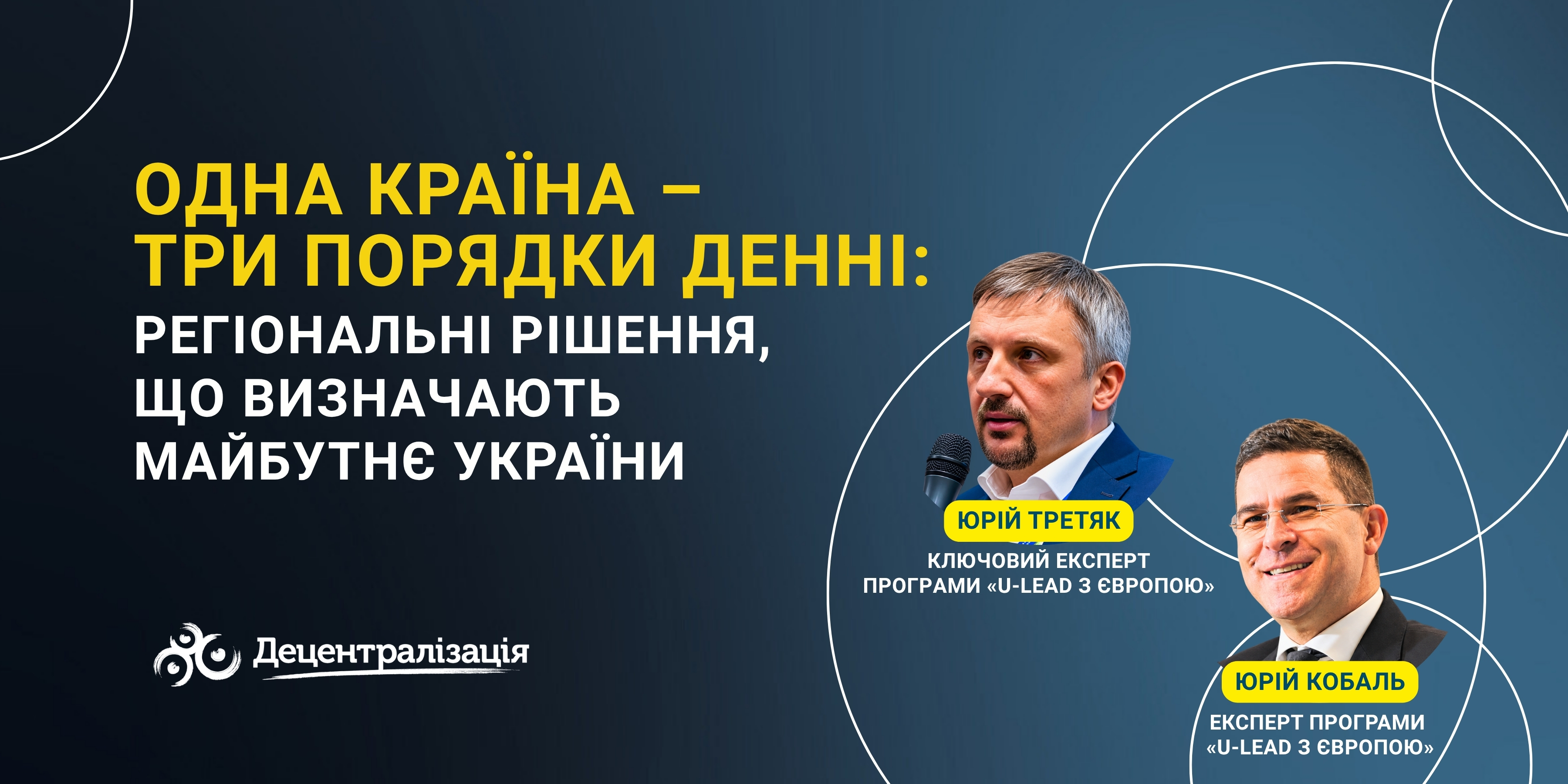
This article was prepared by Yuri Tretyak and Jurij Kobal in the framework of U-LEAD with Europe support to Ukrainian authorities on decentralisation, regional development and preparations related to Ukraine’s EU accession process. It aims to contribute to the ongoing discussion on how Ukraine can respond to the requirements and recommendations linked to Chapter 22: Regional Policy and Coordination of Structural Instruments, with particular relevance for the Ministry for Development of Communities and Territories of Ukraine.
The views expressed in this article are those of the authors and do not necessarily reflect the views of U-LEAD with Europe, the European Union or its Member States Germany, Denmark, France, Austria, Poland and Slovenia.
Yuri Tretyak is a Ukrainian regional development expert with over 25 years of experience in state regional policy, EU Cohesion Policy, decentralisation, public investment governance, and territorial recovery and development. He currently serves as Key Expert on Decentralisation and Regional Development within U-LEAD with Europe, supporting Ukraine’s preparations related to Chapter 22 and the development of an EU-compatible regional and Cohesion Policy system. He has advised national, regional and local authorities, contributed to regional policy legislation and institutional frameworks, and supported the development of regional strategies, investment mechanisms and regional development agencies.
Jurij Kobal is a Slovenian expert in regional development, strategic planning and public policy with more than 30 years of international experience. He works with governments and international organisations on regional and national development strategies, EU Cohesion Policy, institutional development, public investment planning and capacity building. Within U-LEAD with Europe, he supports Ukraine’s preparations for Chapter 22, including the development of regional planning approaches, partnerships, project portfolios and institutional capacities, and contributes to linking practical experience from regions and municipalities with national policy development.

17 September 2026
Уряд визначив функціональні типи територій та пріоритети розвитку громад
Уряд визначив функціональні типи територій та...
Кабінет Міністрів України затвердив зміни до Державної стратегії регіонального розвитку, якими визначено...
17 September 2026
Місцеві бюджети у проєкті держбюджету-2027: огляд ключових змін
Місцеві бюджети у проєкті держбюджету-2027:...
Від редакції. Проєкт Державного бюджету на 2027 рік визначає ключові параметри фінансів громад на наступний рік....
17 September 2026
How the Kryvyi Rih Agglomeration Was Created:...
On 3 September 2026, in Kryvyi Rih, representatives of 14 of the 15 territorial communities (hromadas) of Kryvyi Rih...
17 September 2026
Безбар’єрний пляж в Одесі: як доступність змінює відпочинок біля моря
Безбар’єрний пляж в Одесі: як доступність...
Портал «Децентралізація» розпочинає серію матеріалів про рішення громад, що роблять публічні простори та послуги...