Local budgets in draft State Budget 2027: Overview of key changes
Editor’s note: The draft State Budget for 2027 outlines the key financial parameters for communities for the coming year. The Decentralisation Portal has already reported on the main budgetary indicators. Below, we publish a detailed analysis by the Kyiv School of Economics examining how the structure of local budget revenues, equalisation mechanisms, and community financial autonomy are changing.
The Government submitted the draft State Budget for 2027 to the Verkhovna Rada, and the first thing communities should pay attention to is not the total amount of local revenue forecast by the state, but rather its structure. While local budget resources are growing, this is mainly due to transfers from the Central Government rather than the communities’ own revenues. At the same time, changes to the financial equalisation rules mean that some funds will be earmarked for specific purposes, while the state continues to divert resources from certain local budgets for its own benefit. Read on to find out what the 2027 budget actually offers communities.
The amount of resources allocated to communities
The financial resources allocated to local budgets in the draft budget for 2027 are projected to increase by 20.9%, rising to UAH 1,056.5 billion compared to the revised plan for 2026. However, the source of this growth is more important than the fact that these resources are increasing. Communities’ own revenues are only increasing by 11.8%, to UAH 707.2 billion, while transfers from the state budget are growing almost four times faster, at 44.9%, to UAH 349.3 billion. These transfers include four subsidies totalling UAH 63.4 billion and 30 subventions totalling UAH 285.9 billion.
In 2027, national taxes flowing into the general fund of local budgets are forecast to reach UAH 495.5 billion (+16.7%). As always, personal income tax will account for the largest proportion of this figure at UAH 407.1 billion (+18.3%). Local taxes and fees are projected to remain at last year’s target level of UAH 167.4 billion, which is encouraging given that the 2026 forecast was overly optimistic; this year’s estimate therefore appears more realistic. The revenue is further supplemented by UAH 12.4 billion in non-tax revenues.
Apart from the main debate on transfers, several decisions will also affect communities. From 1 January 2027, the minimum wage will increase to UAH 9,546 (+UAH 899, or +10.4%), while the basic salary for an employee in tariff category I of the Unified Tariff Scale will increase to UAH 3,819. This will directly increase communities' expenditure on public sector wages (education, healthcare, and local self-government), which they finance themselves.
PIT: the same amount, less freedom
The main point of interest in the 2027 budget is the proportion of PIT that remains in communities. As in September last year, the Government is proposing to reduce this share from 64% to 60%. The original 64% provision was intended as a temporary measure for the period 2022–2026, designed to compensate communities for the sharp rise in utility costs caused by rising gas prices. Over the past few years, however, it has become a standard tool for supporting local self-government, so any suggestion of its abolition invariably meets with resistance.
Instead, a subvention of UAH 18.2 billion is once again being proposed to compensate for the difference in heating and hot water tariffs – precisely the sum that the 4% PIT would have generated for communities. While the amount is the same, the difference is significant: communities could have managed PIT revenues at their discretion, whereas subventions are earmarked funding that can only be spent on specific items. The money is the same, but there is less freedom to manage it.
Top 10 transfers: Who will receive the most
The largest transfer remains the education subvention at UAH 192.8 billion, which is an increase of 86.9% on last year. This significant increase is primarily due to a technical factor: last year's pay rise for teachers was approved by the Government after the budget had been adopted, requiring additional funding through a supplementary transfer during the year. In 2027, this item will be included from the outset, taking into account the planned salary increases. The allocation of the subvention among communities will only be determined once the number of schoolchildren on 1 October 2026 has been confirmed, and this process is expected to be finalised by the second reading.
The educational subvention also includes some encouraging details: UAH 10.1 billion has been allocated for public investment projects, including the New Ukrainian School, bomb shelters in educational establishments, school buses, and kitchen facilities, while UAH 400 million has been earmarked for vocational and technical education. A further UAH 495.4 million has been allocated to support children with special educational needs. The full rating of the largest transfers to communities is as follows:
|
Title |
UAH billion |
Compared with 2026 plan |
|
Education subvention |
192.8 |
+86.9% |
|
Basic subsidy |
32.1 |
+4.4% |
|
Additional subsidy to support essential services in frontline or temporarily occupied territories of Ukraine |
30.4 |
= |
|
Subvention for school meals |
19.4 |
+34.5% |
|
Subvention to compensate for arrears in the difference in tariffs for hot water and heating |
18.2 |
new |
|
Subvention for the construction, reconstruction, repair, and maintenance of local roads, streets, and municipally-owned roads in localities |
8.5 |
new |
|
Subvention for financial compensation for housing for veterans and people with disabilities |
6.9 |
+21.6% |
|
Subvention for the implementation of projects under the Ukraine Recovery Programme |
6.8 |
a 7-fold increase |
|
Subvention for the implementation of projects under the Ukraine Recovery Programme III |
5.7 |
an 8-fold increase |
|
Subvention for the provision of safe conditions in schools (bomb shelters, military lyceums, civil defence facilities) |
3.7 |
-38.3% |
Source: State Budget for 2026 (as amended), draft State Budget for 2027
Two new subventions are among the top items in the ranking: one to compensate for the tariff difference and one for roads.
Horizontal equalisation: The rules of the game are changing, but only in terms of data
In 2027, the very mechanism for the horizontal equalisation of the tax-raising capacity of communities may change significantly due to demographic factors. To calculate the basic and reverse subsidies, it is proposed that more recent population data from the State Migration Service is used. While the 2026 budget used data as of 1 January 2022 (32.2 million people), the 2027 draft budget uses data as of 1 September 2026 (28.5 million people, excluding Kyiv and the temporarily occupied territories, which are not included in the equalisation scheme). For these calculations, this data is supplemented by the number of internally displaced persons in each community.
A similar idea was proposed by the Government last year while preparing the 2026 budget, but the decision was postponed due to significant inaccuracies in the data and pressure from local government associations. This time, a 'to-do list' has also been set: by 1 April 2027, local governments together with regional state administrations must update the demographic registers of communities. This data will be used for the equalisation process starting in 2028.
A smaller population in the denominator results in a higher calculated PIT per capita: UAH 7,000.95 compared to UAH 6,049.99 in 2026. This, in turn, directly affects who receives or pays the subsidy. In 2027, 976 budgets will receive the basic subsidy (compared with 1,040 in 2026), of which 15 are regional budgets where the PIT per capita is below UAH 6,300.86. Among community budgets, the threshold is the same and 961 budgets fall below it. Conversely, the number of reverse subsidies has increased to 224 local budgets (compared with 185 last year), of which six are regional and 218 are community budgets, where the figure exceeds UAH 7,701.05 per resident. In 2027, the regional donor budgets (Dnipropetrovsk, Kyiv, Lviv and Poltava regions) will be joined by Volyn and Luhansk regions. The latter will transfer just over UAH 30 million to the state budget due to the specifics of the equalisation formula calculation and will therefore become a reverse subsidy recipient. Equalisation will not be applied to 118 community budgets in temporarily occupied territories, as before. Meanwhile, the calculation for the remaining 1,320 communities is based on expected revenues for 2026.
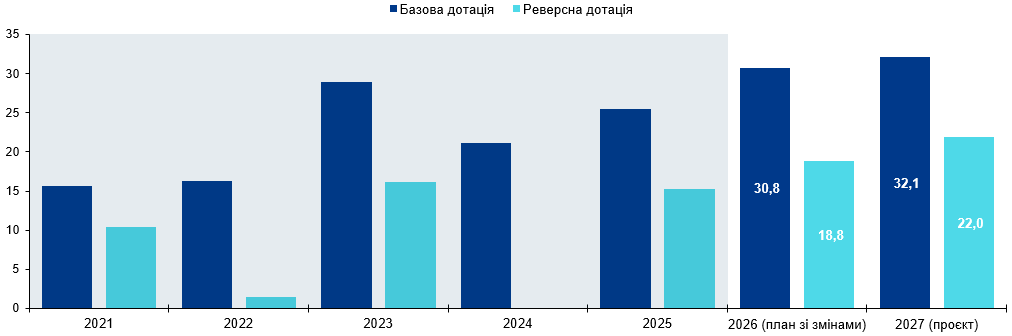
Horizontal equalisation of the tax-raising capacity of territories, UAH billion
Source: State Budget for 2026 (as amended), draft State Budget for 2027, Open Budget portal
The mosaic of transfers: What disappears and what appears
The structure of transfers in 2027 is being significantly overhauled: some of the 2026 subsidies and subventions totalling UAH 8.6 billion are being removed, while new ones amounting to UAH 28.4 billion are being introduced. Notably, the budget will no longer include additional subsidies for territories where hostilities are taking place (UAH 5.2 billion), educational and healthcare institutions (UAH 3 billion), or fire safety in schools (UAH 0.5 billion).
Instead, the budget includes the aforementioned subvention to compensate for the tariff difference (UAH 18.2 billion), as well as a subvention for local roads (UAH 8.5 billion). Only 20% of the latter will be allocated to expenditure, with the remainder being used to repay loan arrears. This represents a partial yet significant restoration of the Road Fund. The list is supplemented by UAH 0.8 billion for access to pre-school education, UAH 0.5 billion to settle debts on the electricity balancing market, UAH 0.3 billion for RES programme projects, and UAH 0.2 billion to restore water supply and sewerage services.
Community development: Resources are allocated, but implementation is in question
In 2027, development expenditure for communities continues to play a secondary role. The State Fund of Regional Development will once again receive only UAH 2 billion, despite inflation and the scale of public investment needs, an amount that remains unchanged year on year. It is proposed that UAH 60 billion be allocated to implementing comprehensive regional and municipal resilience plans and continuing projects in the areas of heat and water supply, sewerage, distributed generation, and critical infrastructure protection, all of which were launched in 2026. However, this substantial sum does not guarantee a high-quality outcome. In the first seven months of 2026, not a single hryvnia was spent on this programme despite a planned allocation of UAH 40 billion. Therefore, increasing funding without removing procedural and organisational barriers risks repeating the same scenario where funds are allocated but projects fail to progress.
When resources do not go to communities, but away from them
Alongside supporting communities, the 2027 budget continues to divert resources away from local level. The most striking example of this is the city of Kyiv, which must compensate the state budget for over UAH 300 million in costs relating to servicing Eurobonds issued in 2025 in exchange for GDP warrants dating back to the 2015 external debt restructuring. The Cabinet of Ministers will determine the terms and schedule for this compensation, which represents a new expenditure commitment for the city budget over which Kyiv has no independent control. This is the second time in two years that funds have been withdrawn from the capital: in 2025, Kyiv transferred UAH 8 billion to the state as part of the income tax redistribution.
Since 24 February 2022, the practice of centralising the remaining funds from the local budgets of territories under temporary occupation has continued – the Treasury automatically transfers these funds to the national level, and the government uses them exclusively to provide housing for internally displaced persons. Another example is the penalties imposed on business entities that do not comply with contracts concluded by budget administrators at all levels and funded from the state budget. These penalties will now be credited in full to the state budget rather than the local budget.
Added to this list is a review of expenditure on maintaining military administrations in temporarily occupied territories. By 1 April 2027, the Cabinet of Ministers and regional military administrations must evaluate their performance and prepare proposals to optimise the structure and network of fund administrators, as well as the operations of municipal enterprises. While this is formally about fiscal efficiency, the issue also has a political dimension: the preservation of these governing bodies, even with limited practical functions, reaffirms the state’s position that these territories belong to Ukraine.
What this means for communities
Ultimately, the draft budget for 2027 does not reduce the resource base of local budgets, which is good news given the backdrop of a full-scale war. Other positive signs include the partial restoration of the road fund, the allocation of funds to the State Fund of Regional Development and a substantial increase in education funding. However, another trend is also evident: the share of communities’ own revenues is growing more slowly than the share of earmarked transfers, while the state continues to divert resources wherever possible – from Kyiv to the temporarily occupied territories. Additionally, the rules for financial equalisation based on new demographic data have not yet been finalised, and the funds already allocated for restoration cannot be used. Communities should closely monitor how these parameters change as the budget is considered in the Verkhovna Rada.


07 October 2026
21 АРР опановують КРОКУС: UCORD посилює проєктну спроможність регіонів
21 АРР опановують КРОКУС: UCORD посилює...
У Львові представники 21 агенції регіонального розвитку розпочали дводенне навчання з розроблення проєктних ідей і...
07 October 2026
Проєкт Держбюджету-2027: громади обговорили ресурс для послуг, освіти та підтримки дітей
Проєкт Держбюджету-2027: громади обговорили...
Фінансова спроможність громад у 2027 році, міжбюджетні відносини, доступність послуг для дітей і сімей стали темою...
07 October 2026
Молодь Хмельниччини та Івано-Франківщини...
Платформа соціальних змін відкрила набір на акселератор Skills Future For Youth для молоді віком 15–29...
07 October 2026
Short-term (by 2027) and mid-term (by 2030)...
This article of the U-LEAD series consolidates the main short-term (by 2027) and mid-term (by 2030) recommendations...