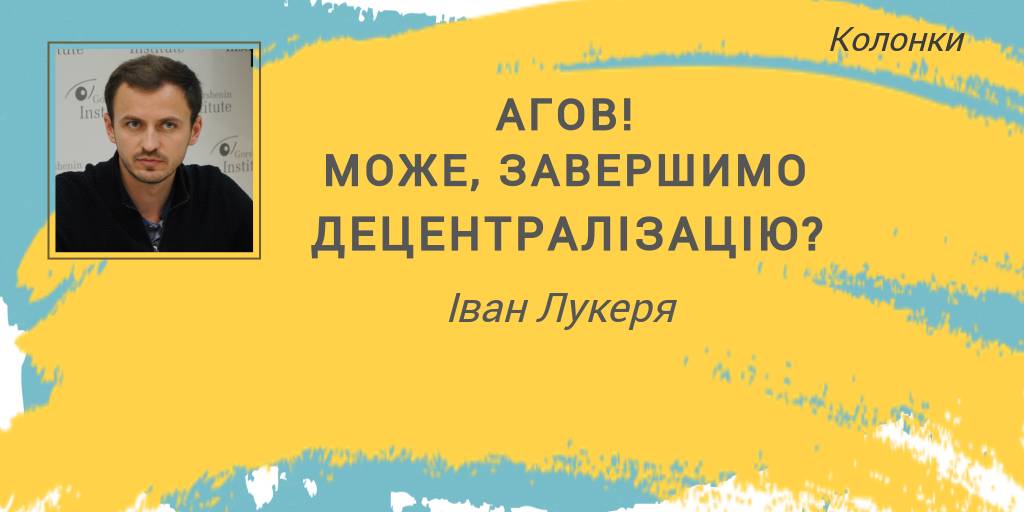
Hey! Shall we complete decentralisation?
By Ivan Lukerya, expert of the Central Reform Office under MinRegion
On 1 April 2014 few Ukrainians seriously accepted ambitious plans for reforming local self-government, decentralisation of power. But in five years decentralisation has become a business card of our country, one of the major reforms that change people's lives for the better.
Life in the regions and hromadas differs from what is shown in the news and post in social networks. There is less betrayal, hype, flood. But there is more effort, work and responsibility. And this gives the result. It is hard not to notice, especially in amalgamated hromadas.
The Solonyanska AH of the Dnipropetrovsk Oblast created a modern European educational institution. The school has an inclusive resource centre attended by children with special educational needs.
The Tyachivska hromada opened a new Administrative Service Centre, where citizens can get all the necessary services.
The Hlybotska AH of the Chernivtsi Oblast works on local economic development, promotes self-organisation and self-employment of hromada residents.
There are already 886 AHs in Ukraine. Almost 70% of the total population live in decentralised hromadas (cities of oblast significance and AHs), that occupy 37.6% of Ukraine's territory.
Local budgets' own revenues grew almost fourfold over these years.
Summing up, I will highlight three main pillars of change being formed by the decentralisation policy.
The first pillar, which is a business card of a decentralised Ukraine, is a new infrastructure.
The second pillar is the formation of trust to state institutions. Sociological studies indicate that 60% of citizens support the continuation of decentralisation policy and consider the reform to be necessary.
And the third pillar, which is associated with “powers - resources - self-government” line is the change of elites. A layer of new managers and local politicians, who have received powers and resources that create real changes in their hromadas, is being formed on the ground.
Therefore, we are obliged to continue the decentralisation policy, which forms the foundation for structural changes in the country, which will be based on the support and trust of citizens.
Happy first of April! Greetings on the 5th anniversary of decentralisation!
The full version is available in Ukrainian – please click HERE

23 October 2026
Для представників громад Харківщини,...
Громадська організація Housing Institute запрошує представників територіальних громад Харківщини, Чернігівщини та...
23 October 2026
Мінрегіон та МОМ посилять підтримку ВПО: житлові рішення та підготовка громад до зими
Мінрегіон та МОМ посилять підтримку ВПО:...
Мінрегіон та МОМ оцінять потреби громад, які приймають переселенців, і визначать пріоритети для залучення додаткової...
23 October 2026
Доступні послуги для кожного: як Тростянецька громада виявляє та усуває бар’єри у ЦНАП
Доступні послуги для кожного: як Тростянецька...
Портал «Децентралізація» продовжує серію матеріалів про рішення громад, які роблять публічні послуги та простори...
23 October 2026
Олександр Корнієнко на Вінниччині обговорив фінансування громад і міжнародні програми
Олександр Корнієнко на Вінниччині обговорив...
Під час робочого візиту на Вінниччину Перший заступник Голови Верховної Ради України Олександр Корнієнко зустрівся з...