Regional policy instruments of Ukraine and the EU: from existing mechanisms to a development management system
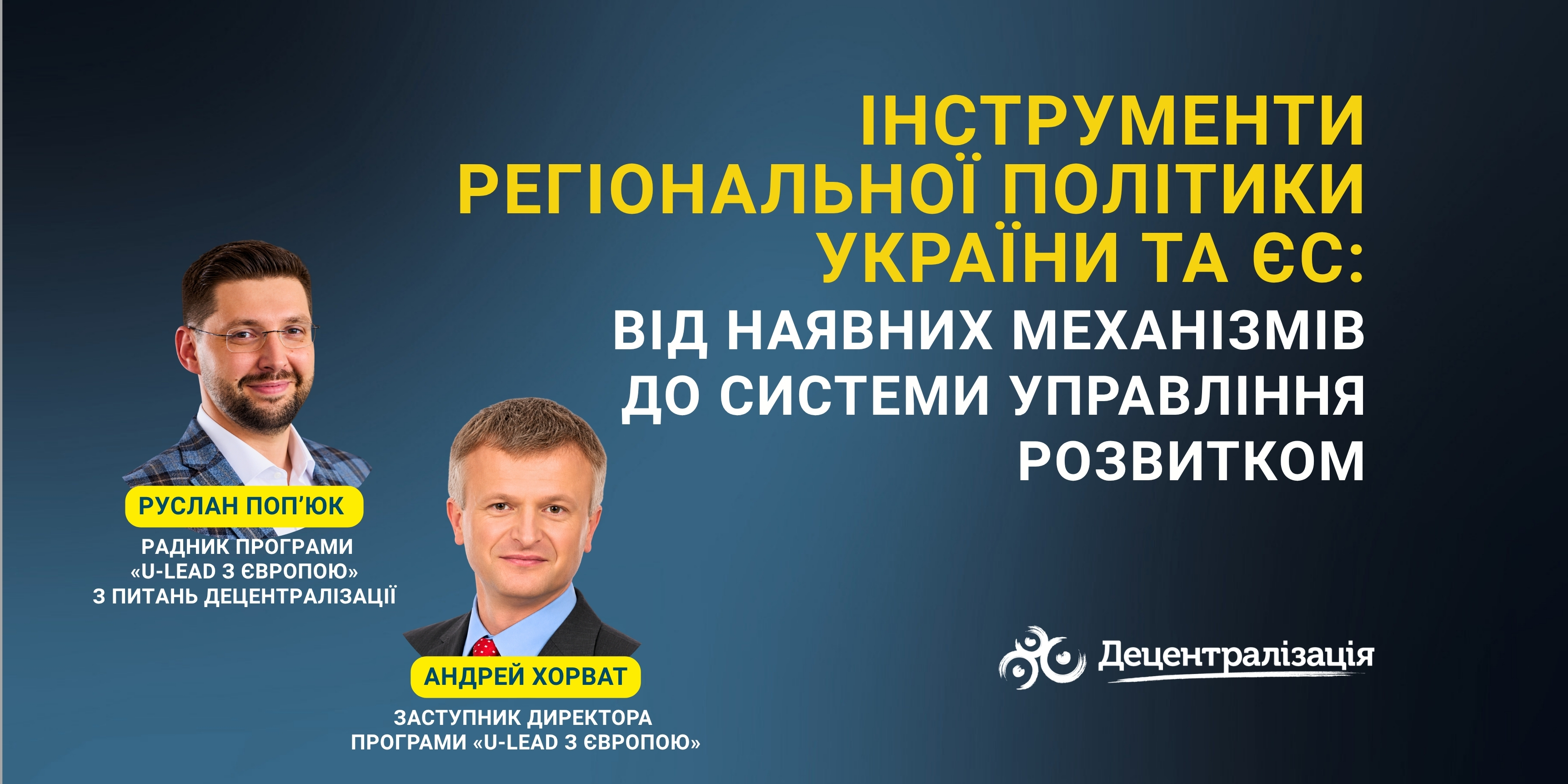
Authors: Ruslan Popiuk, Andrej Horvat
Ukraine’s negotiations on accession to the European Union have fundamentally changed the role of regional policy in public administration. Within the framework of Chapter 22, the issue is not only the formal existence of strategies or funds, but the country’s ability to build a coherent system of instruments compatible with the logic of EU Cohesion Policy. For this reason, the key question is which regional policy instruments already exist in Ukraine, how they function in practice, and what needs to be changed to ensure that, upon accession, they can be integrated into the European model.
The ukrainian model: instruments exist, but there is no coherent system
Ukraine enters the negotiations under Chapter 22 not from a “blank slate.” In recent years, a number of instruments formally belonging to regional policy have been established. The Law of Ukraine “On the Principles of State Regional Policy” defines the governance framework for state regional policy. It encompasses strategic planning, financial mechanisms, institutional architecture, monitoring and evaluation. Thus, at the regulatory level, a system exists. However, the practical functioning of its components and individual instruments demonstrates their limited integration.
1. Planning: a strategy without programming
The core strategic instrument is the State Regional Development Strategy for 2024–2027. It reflects the key principles of European regional policy — a territorial approach, multi-level governance and policy integration. However, the Ukrainian model does not yet include an equivalent to the multiannual operational programmes of EU Cohesion Policy. The Strategy defines objectives and priorities but is not translated into separate programme documents with clearly defined financial allocations, performance indicators and implementation arrangements. As a result, the Action Plan for the implementation of the Strategy is overloaded with numerous initiatives of different levels and does not establish a coherent investment logic.
2. Financing: a sectoral logic instead of a territorial one
The financial architecture of regional development in Ukraine remains fragmented. A significant share of expenditures that can be attributed to regional and local policy is implemented through numerous sectoral programmes managed by different line ministries and budget holders. As a result, there is no single centre of programming, coordination and accountability, which fundamentally contradicts the logic of EU Cohesion Policy.
In substantive terms, regional policy in Ukraine has de facto been reduced to infrastructure investment. Over an extended period, the majority of resources were concentrated on road construction and other physical infrastructure, while investments in human capital, innovation and the economic transformation of territories remained secondary. Such an investment profile does not correspond to the structural logic of regional development embedded in EU Cohesion Policy.
A distinct element of the Ukrainian model is the State Fund for Regional Development (SFRD). In its design, it is the closest approximation to European instruments, as it provides for formula-based allocation of resources and co-financing from local budgets. In practice, however, the SFRD operates predominantly as a mechanism for financing local or object-based projects. Projects with regional or inter-municipal impact remain the exception, which limits the Fund’s capacity to function as a programming instrument of regional policy.
In the context of recovery, the Ukraine Plan under the Ukraine Facility has become the key investment mechanism. Although it contains formal provisions for allocating part of the resources to the subnational level, its architecture remains centralised and sector driven. Priorities, project types and financing rules are defined at the national level, while regions and municipalities act primarily as implementers. Such an approach does not correspond to the principles of territorial programming that underpin EU Cohesion Policy.
3. Implementation: a project-based approach without a programming architecture
Public Investment Management (PIM) plays an important role in the current system of instruments. In Ukraine, this system is primarily oriented towards the technical appraisal of projects and the control of capital expenditure. At the same time, it is only weakly linked to regional strategies and is not used as an instrument of territorial programming. Investment portfolios are formed predominantly along sectoral lines rather than on the basis of spatial and regional priorities or functional types of territories.
4. Monitoring and evaluation: project control instead of development assessment
The DREAM digital ecosystem has become an important step towards increasing transparency and accountability in recovery-related investments. It provides project registration, geospatial tagging, tracking of implementation status and identification of funding sources. However, at present, DREAM functions primarily as a monitoring and reporting tool. Without integration into strategic planning and the PIM framework, it cannot serve as a fully-fledged componentof the programming logic of regional policy.
5. Institutions and coordination: a system in place, but lacking coherence
The Law clearly defines the institutions responsible for state regional policy: the Cabinet of Ministers of Ukraine, the line ministry, regional military administrations and local self-government bodies. Thus, the institutional structure formally exists. At the same time, there is no single authority responsible for the full regional policy cycle – from strategic planning to financing, implementation, monitoring and evaluation – as envisaged under EU Cohesion Policy.
An important role in ensuring coherence is assigned to the Interagency Coordination Commission on Regional Development. It has the potential to serve as a platform where the priorities of different ministries, budgetary decisions and strategic documents are aligned. For this to occur, its functioning must be systematic and linked not only to the discussion of individual decisions, but to the establishment of a coherent regional programming logic.
At present, the interaction between strategies, the budget, the PIM system and digital tools take place primarily through administrative coordination – via document clearances and interministerial procedures. This does not yet constitute a fully-fledged programming architecture in which all elements operate as components of a unified territorial development mechanism.
Taken together, this means that Ukraine possesses most of the individual elements of a modern regional policy framework, but lacks a mechanism capable of linking strategy, financing, investment selection and monitoring into a single territorial development management cycle.
The European approach: regional policy as a development management system
EU Cohesion Policy is built on a fundamentally different logic. It is not a collection of funds or projects, but an integrated system of territorial development governance in which each instrument performs a clearly defined function within the programming cycle – from strategic planning and programming to implementation, monitoring and evaluation, and financing.
The core instrument of this system is programming. Member States implement Cohesion Policy through multiannual programmes agreed with the European Commission, based on Partnership Agreements and (Operational) Programmes. The programme – with clearly defined priorities, financial allocations, performance indicators, and management and control systems – constitutes the basic unit of intervention. Projects are not autonomous initiatives; they are selected as instruments to deliver programme objectives, ensuring concentration of resources, strategic coherence and result orientation.
Financing is provided through the Cohesion Policy funds – the European Regional Development Fund (ERDF), the European Social Fund Plus (ESF+) and the Cohesion Fund (CF). A defining feature of the system is the possibility to combine resources within a single programme. This allows integrated intervention packages that simultaneously address infrastructure, human capital, innovation, SME support and economic transformation within a common strategic framework.
A central feature of the 2021–2027 Common Provisions Regulation (CPR) is the territorial dimension of development. Integrated Territorial Investments (ITIs) enable the implementation of integrated territorial strategies for functional areas – including metropolitan areas, sub-regions or territories facing specific structural challenges – by pooling resources from different priorities or funds around a single territorial strategy. Community-Led Local Development (CLLD) applies a bottom-up approach, empowering local action groups composed of public, private and civil society actors to design and implement local development strategies. Both instruments operationalise the place-based paradigm underpinning Cohesion Policy.
Smart Specialisation Strategies (S3) function as an enabling condition for innovation investment. They require regions to identify priority domains based on competitive advantages and entrepreneurial discovery processes, ensuring concentration of resources and avoiding fragmentation. S3 thus serves as an instrument of strategic selectivity and structural transformation.
In parallel, cluster policies reinforce regional innovation ecosystems by integrating firms, research institutions and public authorities around defined specialisation areas. Clusters are not isolated projects, but coordination platforms embedded in broader territorial strategies, strengthening regional value chains and knowledge spillovers.
Increasingly, Cohesion Policy incorporates results-based approaches, linking financial support to the achievement of measurable outputs and outcomes. The shift from expenditure control to performance orientation reflects a broader emphasis on accountability, effectiveness and impact within the management and control system.
Finally, the partnership principle and multi-level governance are structural elements of the system. In accordance with Article 8 of the CPR, Member States organise partnerships with regional and local authorities, economic and social partners, and civil society organisations throughout the entire programming cycle. This ensures that territorial development is implemented through coordinated action across governance levels, rather than through sectoral fragmentation.
Conclusion
A comparison between the Ukrainian model and EU Cohesion Policy demonstrates that the key gap does not lie in the absence of instruments as such, but in the absence of a programmatic and territorially oriented architecture that integrates them into a single development management cycle. Ukraine already possesses most of the necessary elements – strategies, financial mechanisms, a public investment management system and digital tools. However, without their integration into a common programming logic, they will remain fragmented components rather than parts of a coherent system.
The transformation of regional policy towards full-fledged programming, territorial concentration of resources and clear institutional coordination is not merely a formal requirement under Chapter 22, but a necessary condition for the effective use of future EU Structural and Investment Funds. Without such restructuring, even formal access to Cohesion Policy resources will not guarantee the structural development of territories. Ultimately, the ability to align existing instruments within a coherent system will determine whether EU membership becomes an instrument for development for Ukraine, rather than merely a political status.
Ukrainian legislation does not contain a legally defined concept of a “regional policy instrument.” The Law of Ukraine “On the Principles of State Regional Policy” operates with the notions of strategies, programmes, projects and financing mechanisms, but does not introduce a separate legal category of “instrument.”.
Similarly, Regulation (EU) 2021–2027 (Common Provisions Regulation, CPR) does not provide a single, concise definition of “cohesion policy instruments.” Instead, it defines the funds, territorial mechanisms and implementation tools through which Cohesion Policy is delivered. Therefore, in this article the term “instruments” is used in a functional sense – as the set of mechanisms through which regional policy and territorial development governance are implemented.
This article has been prepared by Ruslan Popiuk and Andrej Horvat within the framework of support provided by U-LEAD with Europe to Ukrainian authorities in meeting the recommendations of the European Commission set out in the Ukraine Enlargement Reports concerning Chapter 22 “Regional Policy and Coordination of Structural Instruments”. The contents of this article are the sole responsibility of its authors and do not necessarily represent the views of U-LEAD with Europe, the European Union or its Member States Germany, Denmark, France, Austria, Poland and Slovenia.
Ruslan Popuk is an international relations professional with more than 13 years of experience in European Integration, Regional and Local Development, Decentralisation, International Cooperation and Technical Assistance. He holds a Master’s degree in International Relations from Taras Shevchenko National University of Kyiv and completed the Academy of Good Governance and Empowerment in Europe at the European Academy Berlin.
From 2013 to 2023, he worked at the Kyiv City State Administration and the Ministry responsible for regional development of Ukraine, focusing on international cooperation, decentralisation and local self-government reform.
Since March 2023, Ruslan Popiuk has been with U-LEAD with Europe as a Decentralisation Adviser, supporting Ukraine’s EU accession process in the area of regional policy and Chapter 22 – Regional Policy and Coordination of Structural Instruments.
Dr. Andrej Horvat is an economist with long lasting experience in the fields of Transformation Processes, Good Governance, Structural and Public Administration Reforms, Local Development Policy, and EU Integration. He obtained his PhD degree from the Vienna University of Economics and Business Administration.
From 1997, for more than 10 years, he used to work in different managerial positions of the Government of the Republic of Slovenia. From 2011 till 2017 he was leading the project supporting Serbian authorities in preparing for EU Accession Negotiations, financed by the German government.
As of September 1st, 2017, Andrej Horvat is with the U-LEAD with Europe in Ukraine working as Deputy Programme Director, heading the Sustainable Development Unit dealing with regional/ local development and EU Accession/ Chapter 22 Regional Development and Coordination of Structural Instruments.
22 September 2026
Capacity building and empowerment of local communities in Ukraine
Capacity building and empowerment of local...
This article of the U-LEAD series identifies the additional and strengthened capacities that Ukrainian local...
22 September 2026
Polaris Programme Selects 13 Rural Hromadas for Cooperation to Strengthen the Starosta Institution
Polaris Programme Selects 13 Rural Hromadas for...
Following the Open Call, 13 rural hromadas from 8 oblasts of Ukraine were selected for cooperation with the...
22 September 2026
Жити містом, а не долати його. Як безбар’єрний...
Безбар’єрність міського простору починається з конкретних рішень, які дають людям більше самостійності у щоденному...
22 September 2026
Tender: Support to preparation of Development...
The Polaris Programme: Support to Multi-Level Governance in Ukraine invites eligible tenderers to submit...