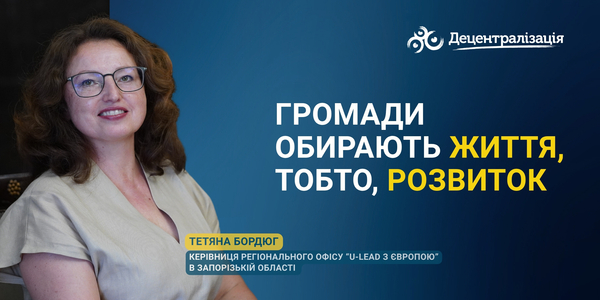
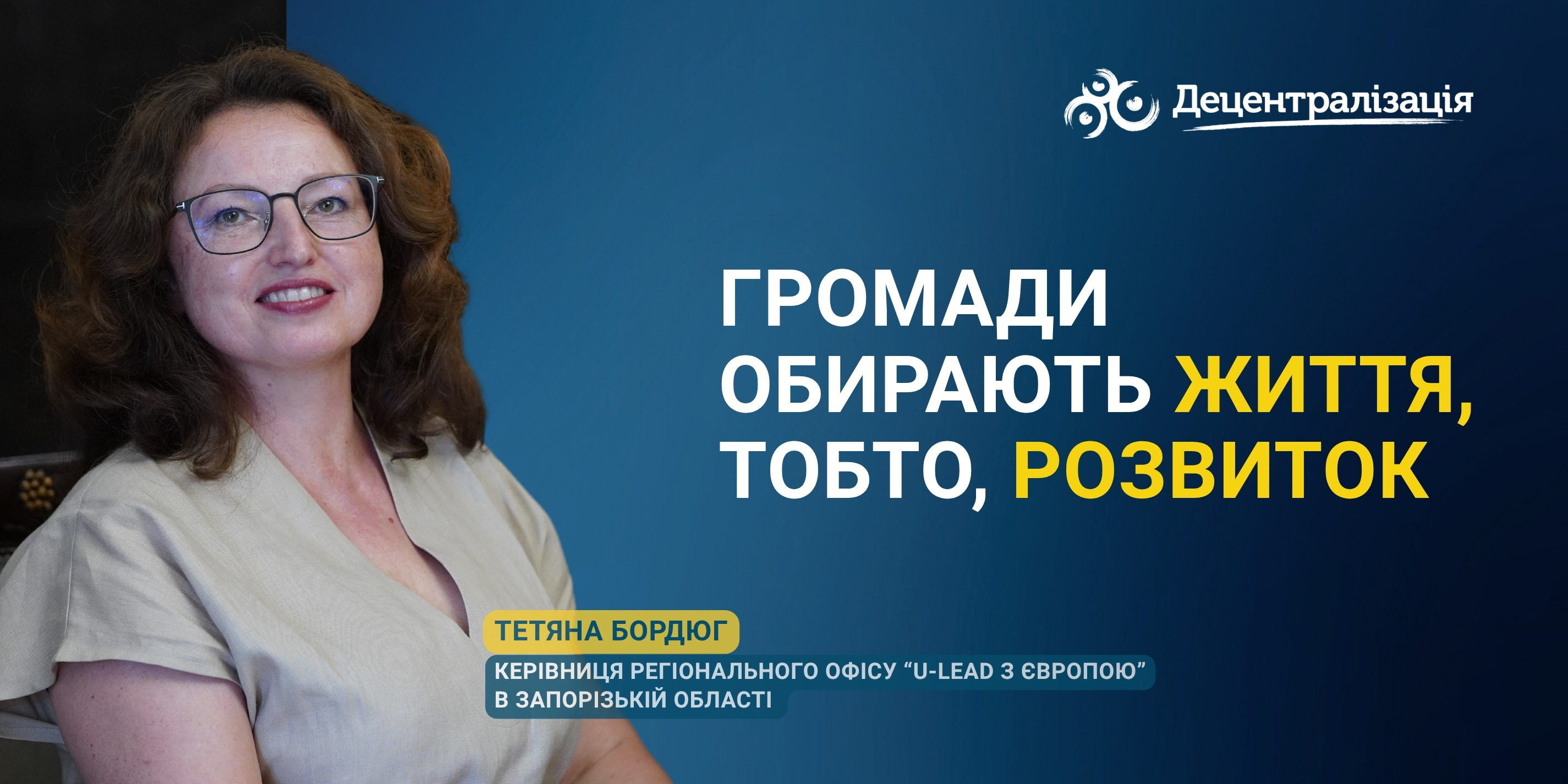
Tetiana Bordyug: ‘Communities choose life, which means development’
Tetiana Bordyug, Head of the Regional Office of U-LEAD in Zaporizhzhia region on unconventional approaches to work and investment in the development of communities in times of war
By Dmytro Syniak
The full-scale war has completely changed the lives of Ukrainian communities. For many of them, development issues were replaced by concerns relating to survival, security, and recovery. At the same time, strong local self-government has become one of the key factors in the resilience of the country. Under these circumstances, support for communities from international partners has taken on particular significance, with U-LEAD with Europe playing a key role. U-LEAD helps communities to strengthen their administrative capacity, plan for restoration, implement modern approaches to development, and prepare for EU accession. Decentralisation spoke to Tetiana Bordyug, Head of the Regional Office of U-LEAD in Zaporizhzhia region, about the challenges communities in Zaporizhzhia region are currently facing, support for local governments, international cooperation, and priorities for restoration.
Zaporizhzhia is Ukraine “in miniature”
The withdrawal of USAID from Ukraine deprived our communities of many opportunities. Does this mean that U-LEAD with Europe has taken on an additional burden?
Indeed, of the major donor-funded projects aimed at all communities without exception, U-LEAD is now the only one remaining in Ukraine. And so, yes, the burden on us has increased. But our ability to make a difference has also grown.
How are you currently organising your work in such a difficult situation, given that Ukraine – and Zaporizhzhia region in particular – comprises frontline, rear, temporarily occupied, and partially occupied communities?
Of course, this diversity presents a certain challenge for us. However, it is interesting that this feature makes Zaporizhzhia region like Ukraine in miniature. Therefore, many of the approaches we apply here can subsequently be scaled up to the whole country. On the other hand, Zaporizhzhia region is the only one in Ukraine where all the relocated local governments are based in the regional centre: usually they are scattered across the whole country. This situation has both its pros and cons. The greatest advantage is that employees of the relocated local governments can easily meet, discuss pressing issues, and share experiences. They often come to our office, and we also visit different communities when necessary; this accessibility undoubtedly benefits our common goal. On the other hand, when 42 communities with identical requests turn up in the regional centre at roughly the same time, it turns out that the city cannot meet these requests. It cannot rent out 42 schools where displaced children could study, even if it were to introduce a second shift everywhere. In fact, it is difficult for the city to find premises for the municipal services of such a large number of communities. In other words, the relocation of so many administrative bodies to Zaporizhzhia poses a serious challenge for the city authorities…
With such a variety of working formats and, consequently, objectives, it is probably very difficult to operate. How do you avoid administrative chaos?
What helps us enormously is that all our regional office employees are residents of Zaporizhzhia. This means we are on the same page as all our communities, regardless of whether they are in an active combat zone or not, or whether they are in the rear or under occupation. Moreover, we have known many community leaders personally since the time of the amalgamation, which, by the way, we actively supported. And now these communities see us as a friend and partner. They are always willing to meet us halfway and are ready to take up all our proposals. They also all know that they will always find support and assistance from us. What am I getting at? Under such circumstances, a tailored approach works very effectively. Nevertheless, to avoid chaos, we have reorganised our work. Whereas previously the aim of each of our U-LEAD regional offices was to develop its own region, our offices now work for the whole of Ukraine. At the same time, each office has working groups, each dealing with its own specific area. In this way, we focus not on the format of the community, but on its needs. And if any community needs help – for example, with evacuating people – we have experts who specialise exclusively in this area. To them, it makes no difference where the community is located: under occupation, on the front line or in the so-called rear.
How did the idea for such a comprehensive reorganisation of U-LEAD come about?
From communicating with community leaders. We bring them together at our office twice a year. We also constantly exchange ideas during these meetings – this is a very dynamic process. It helps us find the best possible solutions. But community leaders naturally form a kind of community, for which we serve as a platform for interaction. We act as moderators at these meetings, those who set the agenda for discussion.
Is it possible to invest in the development of communities during a full-scale war?
We are all currently witnessing a very unusual process: in the fifth year of a terrible, bloody war, during which entire cities are destroyed, people are at the same time working to develop both their communities and the country as a whole. What do you think about this? And how do you see the development of Zaporizhzhia region – even whilst hostilities continue?
You are absolutely right. Whilst in the first years of the war communities were mainly concerned with survival – creating databases, setting up alert systems, and delivering humanitarian aid – by 2023 everything had changed. Back then, all communities were absolutely certain they would soon return home, and they were preparing for that accordingly. Then came a period of disillusionment, when everyone’s spirits were low, but that too has now passed. You realise that you have to live. And the communities live. They choose life. The essence of life lies in development. That is where this trend stems from. Here is where we come in, helping communities to develop new projects and attract investment.
Investment? Is that really possible? Zaporizhzhia is only about 50 km from the front line…
I used the word “investment” in a broad sense. We are not talking about business investment. Communities can raise funds for the development of the public sector, for initiatives to foster cohesion, for the provision of social services, for the education of their people, and the like. All of this is also about community development. For example, in 2024 we helped Kushuhum community open a centre for the elderly. There, they can learn computer skills whilst socialising with children. There is also a library and a dance group. A community hub has formed around this centre, acting as a focal point.
How much did this project cost U-LEAD?
Just UAH 2 million, which I regard as an investment in the future of the community. Most importantly for us is that, in this way, we prepare communities for Ukraine’s restoration. I have no doubt whatsoever that, sooner or later, funding from international institutions will be channelled towards this restoration. But we have to be ready to receive and use these funds. We need to find local residents who are willing to return to restore their communities. Another area of interest for us is preparing communities to adapt local policies and administrative decisions to European Union standards. This involves new regulations that will need to be introduced. People need to be ready for this.
What areas is U-LEAD currently working on? Which aspects of your work are most relevant to communities in Zaporizhzhia region?
For example, we are currently working on developing a roadmap for establishing international partnerships. This is a very important issue, as our country is now literally fighting to become part of the European Union. So we are trying to develop a framework that will enable every community to find partners in Europe. Shyroke and Mykhailivka communities already have excellent experience in this matter. Alla Korol, Head of Mykhailivka community, has a very interesting and inspiring story about her search for European partners. She even travelled to Rome last year for this purpose – to attend the Ukraine Recovery Conference (URC). Sadly, community leaders often believe that nobody in Europe needs them, and that finding a partner is almost impossible. But they are wrong. And here, joint meetings are a great help, as they break down the wall of despair. Then you simply receive a step-by-step plan, follow it, and achieve results.
Which U-LEAD projects, implemented during the war, are you most proud of?
In Shyroke community, we helped create a Career Centre for children, where they can learn about a range of professions. High school students undergo career guidance training there, work with a career counsellor and, in this way, gain a better understanding of themselves and accurately assess their inclinations and talents. In my view, this is also a development project. Generally speaking, I have to say that development projects are the cornerstone of U-LEAD. We have always tried to give people a fishing rod rather than a fish. Of course, at the start of the war we also got involved in providing emergency aid to communities, but now we have returned to our core mission. Our main areas of work are: advising, raising awareness, sharing experience, and bringing communities together.
The importance of quality charters
There is an opinion that the administrations of occupied communities are not necessary, as they practically duplicate the functions of local self-government in the territories to which their residents and municipal enterprises have been relocated. Opponents of this view argue that these administrations help to preserve at least some sense of regional identity, which is very important to displaced people. What do you think about this? To what extent do relocated communities actually manage to preserve their identity?
This is a very important question, because this regional identity is, in fact, all that remains for internally displaced persons of the place where they were born and grew up. Therefore, they really need a connection with their fellow citizens. And that means we need someone to maintain that connection. After all, what is a community? It is a territory and its inhabitants. Many communities have lost their territories, but the residents remain. So, we can say that the community is there, that it exists. It is counterproductive for the state to deprive it of its coordinating centre. After all, there are cases when not only residents are relocated. Take, for example, Polohy community… Not only have most of its residents moved to Zaporizhzhia, but so did its schools, healthcare facilities and, most importantly, its businesses. Have you heard of the company “Dobra Hlyna”, which makes pottery? It is from Polohy, and now this company operates in Zaporizhzhia, continuing to contribute to the budget of Polohy community! Meanwhile, the Polohy sewing workshop actively produces a range of merchandise bearing the community’s logo. And it sells well, because people want to show that ‘We’re from Polohy.’ This is important to them. And so, the community’s identity is largely shaped around the local government, which acts as a facilitator.
What are the most common requests from communities?
Just yesterday, a partially occupied community approached us with a request to draft a charter for them. According to the law, every community, without exception, must have such a charter by 1 January 2027. The same applies to development strategies.
The strategy is difficult to develop: for it to be of high quality, maximum participation from residents is required. But the charter… Isn’t that just a typical formal document? What makes it so difficult to draft?
Sometimes drafting it is even more difficult than developing the strategy. And it is undoubtedly more important than the strategy, at least when it comes to international partnerships. Foreign partners first ask to see the charter, and only then the strategy. Because the charter sets out the relationship between the community leadership and residents: the procedure for holding public hearings, the procedure for appointing people to key local positions, the procedure for submitting petitions, and other matters. In general, this is what is known as self-government – the charter is a set of rules for this self-government. And each community may have its own rules. So, basically, the charter is a community agreement between the leadership of the community and its residents. And adopting this agreement certainly requires discussion. In other words, drafting a high-quality, effective charter is no easy task, hence our assistance is very much needed here. Our working groups and the experts we engage help communities to draft charters tailored specifically to their particular circumstances. Right now, for example, we are helping to draft a charter for Orikhiv community, which is partially occupied and where active hostilities are ongoing. We work with both the community leadership and the residents, helping them to work together where necessary. The same applies to the drafting of strategies.
Do you also help draft strategies for temporarily occupied communities? What can be planned for them, though? And how serious is such planning? No one knows how the war will end, after all.
This is indeed a very painful matter, and apart from us, practically no one else is taking on the task of drafting such strategies. A few weeks ago, we participated in a conference involving the relevant ministries, which was dedicated to Ukraine’s implementation of Chapter 22 of the plan for Ukraine’s accession to the EU. This chapter is devoted to regional policy. One of the key points raised was that a plan for Ukraine’s restoration, at least in broad terms, needs to be developed now. Once the war is over, frontline and occupied territories will need to be redeveloped in line with their population numbers and the state’s objectives and priorities. In other words, no one will rebuild a school simply because it used to stand there. And we should already have several scenarios in place. Development strategies for occupied communities should fit within these scenarios. On the other hand, the law requires such strategies to be in place, and communities must comply with this requirement.
Lessons in resilience
What currently motivates communities most to plan their own future?
People are driven by a desire to help others and a sense of responsibility to them. Our main target audience is communities with a population of up to 50,000. In other words, we work with small cities, mainly villages and settlements. There, more often than not, the community leader knows the majority of their residents. So, what drives and motivates them most is their sense of responsibility to each and every person, to every resident. The terms of office for community leaders would have ended last year had it not been for the war, and some of them tell me quite frankly, ‘I would have stepped down long ago, as my term has ended. But then an elderly woman comes to me, for whom I am her only hope. How can I turn her down? After all, I’m the only one who remembers how we did such-and-such and where to get the documents she’s asking for.’ Local government employees are also inspired and motivated by the dream of returning to their hometowns. To return and start life afresh.
Is that possible? Could you tell us if there are any examples where, thanks to U-LEAD programmes or training, communities have been able to launch new initiatives or strengthen their own capacity?
There are many such examples, because we are, in fact, a catalyst and a driver of change. Even simply communicating with us often provides a powerful impetus for community leaders to take action. To be more specific, the cornerstone of our work is the drafting of documents which communities should then follow. For example, they are already starting to provide services in line with the procedures we teach them. And I can proudly say that the standard of service provision in many communities already meets European standards. We also have the League of Leaders programme for community leaders, which is now in its third year. During the training, community leaders not only exchange experiences but also acquire skills in communication, project management and much more. We also have a special initiative called “Outposts”, designed for communities near the front line. Within the framework of this initiative, communities work with us to develop a package of measures that they can implement should active hostilities draw near. In other words, our work basically consists of preparing communities for the many challenges that life, war, and the law present to them.
What could the whole of Ukraine learn from the communities in Zaporizhzhia region?
The art of survival. How, in the difficult conditions of war – amidst relocation, hostilities, the loss of assets and funds, and so on – can they continue to provide services to their residents? How to educate their children in schools? How to provide people with healthcare, electricity, water, and food? How to keep people within the community? Local governments in our region know the answers to these questions… At times, they face very difficult challenges. Take, for example, Mykhailivka rural community, where more than 4,000 of the 7,000 residents are internally displaced persons. In other words, more than half the population needs assistance, employment, housing… Can you imagine how overwhelmed the village council becomes under such conditions, and how many functions it has to take on that are completely new to it? This is where our help becomes extremely valuable.
What do you find most valuable about your work?
I am truly impressed by the ability of local government officials to adapt and adjust, by their flexibility and their resilience. Despite being public officials, they are ordinary people who have lost their homes and, at times, their loved ones. Many of our community leaders have also endured the horrific experience of Russian captivity. And despite all these circumstances, they not only continue to perform their duties, but also find the strength to think of new ideas, seek new horizons, and inspire their teams and residents to develop. Their resilience and strength of character are always an inspiration, and the inspiration they generate is what I love most about my work. The unbreakable spirit of our people makes my work easier and fills it with a special inner meaning.
15 October 2026
Правовий режим майна закладів освіти...
правовий статус майна комунальних закладів освіти та повноваження засновника і керівника закладу; які...
15 October 2026
«Я цінний для своєї громади й держави». Як у...
У Зимнівській громаді на Волині профорієнтація перестала бути формальністю. Тут не просто розповідають про...
15 October 2026
У Балті відбудеться регіональний форум «Доброчесність у громаді: від принципів до практичних дій»
У Балті відбудеться регіональний форум...
Як зробити доброчесність частиною щоденної роботи місцевого самоврядування? Які практики вже працюють у громадах і як...
15 October 2026
Що для підлітків важливіше – почути про...
Саме про це говорили під час молодіжної діалогової платформи на Національному форумі «Майбутнє, яке обираємо ми!»,...