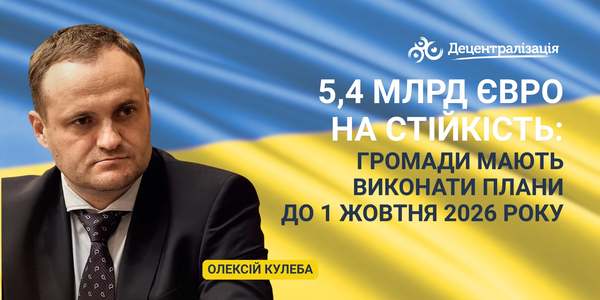
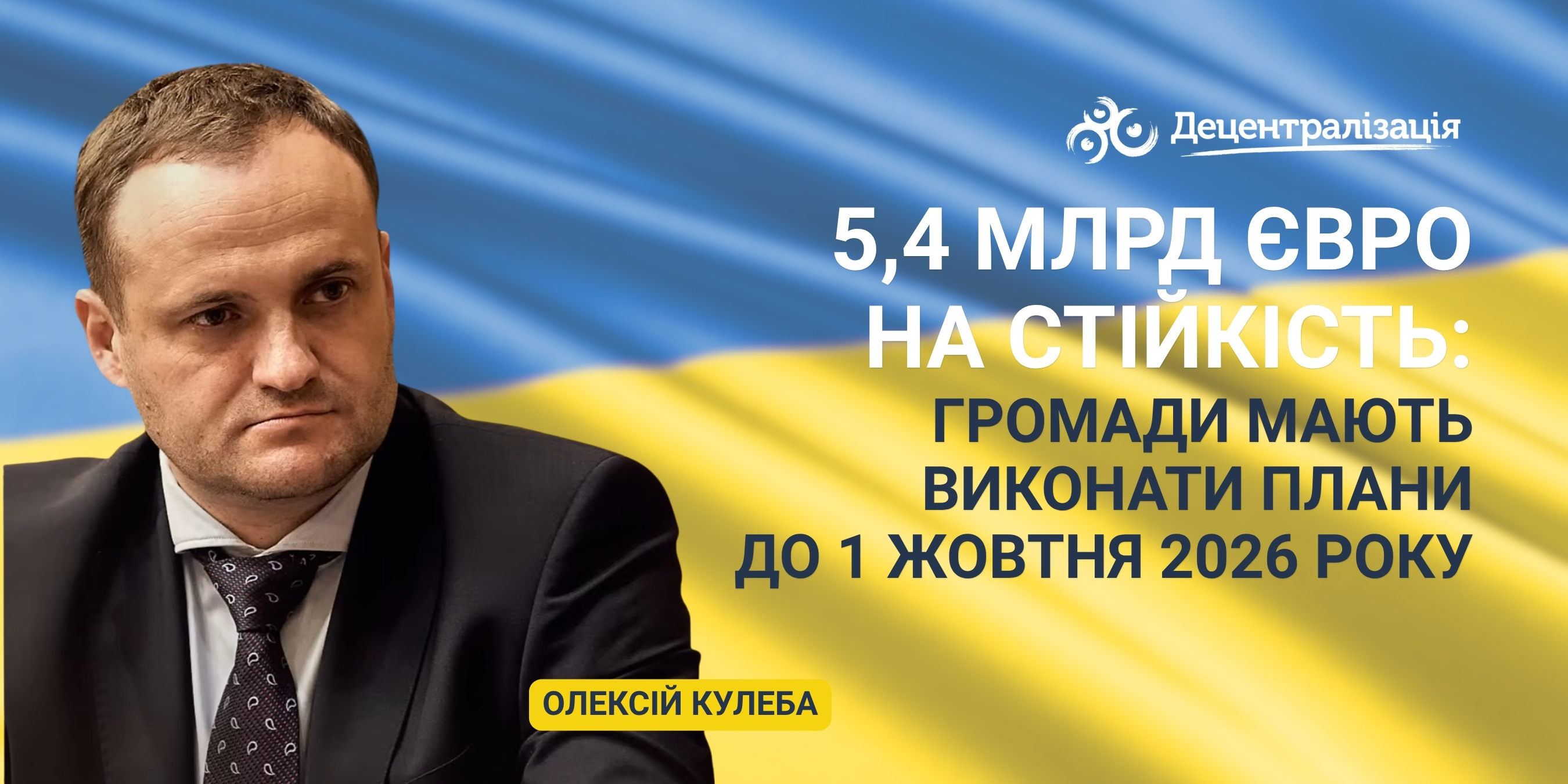
‘EUR 5.4 billion for resilience: Communities must implement their plans by 1 October 2026’ – Oleksii Kuleba
Oleksii Kuleba, Deputy Prime Minister for Restoration of Ukraine – Minister for Development of Communities and Territories, in an interview with the National Telethon spoke about the Government’s priorities, which have a direct impact on the activities of local governments. The main topic was the resilience plans approved by the National Security and Defence Council, which are developed ‘from the community up’, as well as programmes for the restoration of housing and support for territories.
The Deputy Prime Minister reminded that in early March, the National Security and Defence Council approved resilience plans for regions and individual localities. Oleksii Kuleba emphasised that this work had begun long before – back in January, when the enemy’s targeting of critical infrastructure in major cities became clear.
The key principle is the development of plans ‘from the community to the national level’.
‘We began working with the regions, provided relevant proposals, and structured each region according to the principle of moving from the community to the national level; in other words, all the current projects are, for the most part, initiatives that originated within the communities,’ noted the Deputy Prime Minister.
The resilience plans are based on four areas:
- Protection of critical infrastructure.
- Distributed generation (alternative energy system).
- Alternative heat generation.
- Alternative water supply.
The total cost of the plan is EUR 5.4 billion (over UAH 230 billion). These figures have already been communicated to international partners. Priority is given to:
- frontline territories (the country’s security zone);
- large critical infrastructure facilities that are vital to the livelihoods of a significant number of people.
‘Every region and every locality that participates in the implementation of the resilience plan must fulfil specific tasks by 1 October 2026. ... The implementation of the resilience plan is monitored daily, and this will continue until we have completed them. Because this is a matter of national security, it is a matter of the survival of our localities and their critical infrastructure,’ emphasised Oleksii Kuleba.
The Deputy Prime Minister reported that Ukraine’s total losses, according to the World Bank, are estimated at EUR 584 billion. The following have been destroyed or damaged:
- over 30,000 apartment buildings;
- over 200,000 private homes.
In March 2026, the eVidnovlennya programme issued compensation to 185,000 families.
From April 2026, a new component of the programme will be launched: payments for property lost in the temporarily occupied territories. Compensation will be prioritised for:
- servicemen of the Armed Forces of Ukraine;
- people with disabilities in categories I and II.
‘There are 30,000 requests. These are, primarily, our servicemen... and people with disabilities in categories I and II. Therefore, we are already starting to make payments from April. People are waiting, and we are, of course, in a hurry to provide them with this service,’ said Oleksii Kuleba.
The Deputy Prime Minister added that other categories of citizens who left property in the temporarily occupied territories will receive compensation gradually.
The heating season and preparations for the coming winter
Despite a difficult winter and targeted attacks on thermal power generation, 99 per cent of apartment buildings remained heated. The heating season has already ended in six regions.
The task for the future is to provide cities with centralised heat supply with a back-up plan.
‘Today, we face the task of ensuring that all our cities supplied with centralised heating have the option of a back-up plan, so that in the event of damage or destruction to their generating stations, whether thermal or power stations, they can nevertheless continue to provide assistance and services to our people,’ emphasised the Deputy Prime Minister.
Seventy-two community renewal projects: Hospitals, schools, bomb shelters
Oleksii Kuleba paid particular attention to the programme for the restoration of communities. This is already the fourth phase of such a programme, in which seven regions have taken part. Seventy-two projects have been selected, with the voice of the community itself being of decisive importance.
‘The portfolio of 72 projects includes many hospitals, many educational institutions, and many projects related to the construction of bomb shelters, because communities care about their own safety and the safety of their residents. We are doing this in partnership with our international friends, with our partners, namely the European Investment Bank,’ noted the Deputy Prime Minister.
As an example of successful implementation, the Deputy Prime Minister mentioned the project to restore the water supply in Mykolaiv. The initial cost of UAH 8.5 billion was reduced to UAH 6.2 billion thanks to the optimisation of the project documentation by the Agency for Restoration.
‘Mykolaiv will receive not only drinking water... but also a whole range of facilities, including temporary structures. And Mykolaiv and Mykolaiv region will be provided with a modern water and water quality facility, which is unique in Ukraine today,’ summarised Oleksii Kuleba.
The full interview is available here
18 September 2026
Віталій Безгін: підтримка громад має враховувати функціональний тип території
Віталій Безгін: підтримка громад має...
«Українські громади дуже різні за безпековими умовами, географією, економікою та потребами людей. Тому й державна...
18 September 2026
Вакансія: Експерт(-ка) з дошкільної освіти
Вакансія: Експерт(-ка) з дошкільної освіти
Опис контексту Щоб задовольнити мінливі потреби українських муніципалітетів і зацікавлених сторін на національному...
18 September 2026
Вакансія: Експерт(-ка) з місцевих фінансів (в напрямку «Фінансова децентралізація»)
Вакансія: Експерт(-ка) з місцевих фінансів (в...
Опис контексту Щоб задовольнити мінливі потреби українських муніципалітетів і зацікавлених сторін на національному...
18 September 2026
Управління відходами – з чого почати? Шість продуктів, які полегшать громадам роботу
Управління відходами – з чого почати? Шість...
Якщо ви займаєтесь управлінням відходами чи приблизно уявляєте собі обсяг робіт, напевно, не раз задумувались: як це...