Support and timely assistance: How the first psychosocial support centres operate. PRO_MentalHealth for veterans and their families
September 2025 marks two years since the first PRO_MentalHealth psychosocial support centres were established in the Rivne region.
In 2023, the Rivne region became a pilot region for the implementation of the ‘Psychosocial Support in Ukraine’ (PRO_MentalHealth) project, which was implemented by the International Solidarity Fund PL Representative Office in Ukraine in partnership with BGK, the European Commission and with the support of the Polish Development Cooperation Programme of the Ministry of Foreign Affairs of the Republic of Poland. The Ministry of Social Policy, Family and Unity of Ukraine and the Ministry of Veterans Affairs of Ukraine also joined the implementation. As part of this initiative, psychosocial support centres were established in the four districts of the region: in the Zdolbuniv, Dubno, Sarny and Volodymyrets communities.
These Centres have been established to help Ukrainian society overcome the consequences of war and provide support to various groups, primarily military personnel, combatants, families of deceased or missing soldiers, and internally displaced persons.
The PRO_MentalHealth model, which is used to create psychosocial support centres in communities, is based on several fundamental principles:
- sustainability of the created centres: ensuring long-term operation of the centres regardless of external circumstances;
- wide range of services: providing comprehensive assistance in accordance with the needs of recipients (psychological, informational, physical and sports rehabilitation, consultations with social work specialists, legal assistance and career guidance counselling);
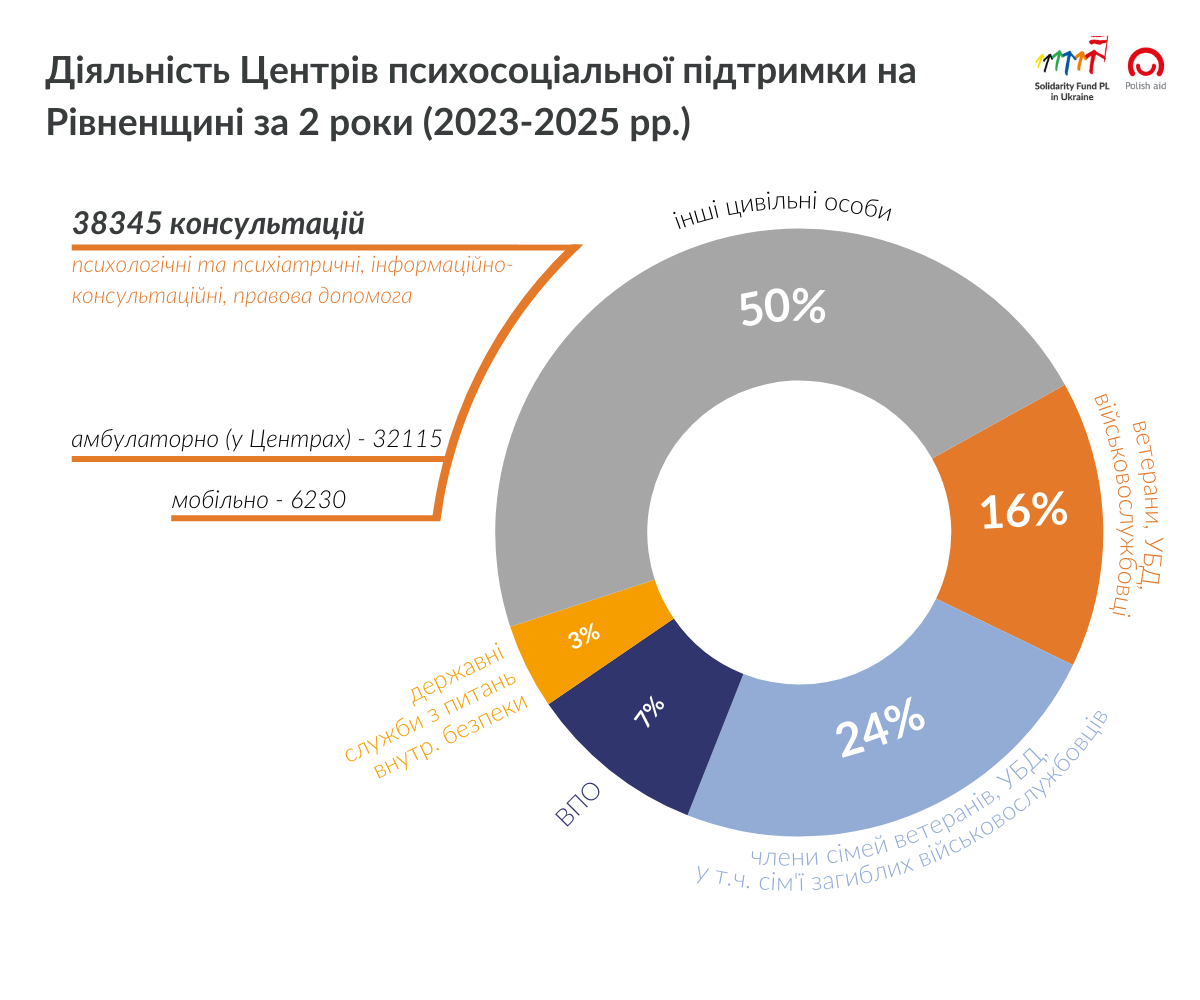
- accessibility at the local level: services are as close as possible to the place of residence of people who need them. Services are provided on an outpatient and mobile basis (by sending mobile teams of specialists to localities within the community and/or district that are remote from the Centre);
- high quality of services: compliance with professional standards, training of staff and monitoring of effectiveness;
- ecosystem of interaction: close cooperation between regional and local institutions, ensuring the integrity and sustainability of support.
Within the scope of the project, four communities received financial and methodological support for creating and establishing the centres, including renovation of the premises, purchase of equipment and a vehicle for the mobile teams. They also received training for the specialists and, during the first six months of operation, financing for salary costs. Then, grants were provided for developing new services. Thanks to this support, the centres were able to provide services within the district and not just within their own communities during the initial establishment period. As stated by Tetiana Siryk, Head of the Pro_MentalHealth Psychosocial Programme: Psychological Rehabilitation and Social Adaptation of Veterans and War Victims in Ukraine, of the International Solidarity Fund PL Representative Office in Ukraine, the Centres have provided mental health services (psychological and psychiatric consultations) and information services to promote the Centres and overcome the stigma against receiving psychological help. However, in response to requests and suggestions from service recipients, the range of services offered by the Centres has expanded, now including physical and sports rehabilitation, consultations with social work specialists, legal assistance, and career guidance counselling.
Each Centre employs a multidisciplinary team of specialists: a psychologist, psychiatrist, social worker, physiotherapist, and lawyer.
Since 2024, the Centres have either been funded by local budgets or have attracted funding for specialists through state programmes run by the Ministry of Social Policy, Family and Unity of Ukraine, and the Ministry of Veterans Affairs of Ukraine.
‘The creation of Psychosocial Support Centres is important for two reasons: firstly, to provide professional assistance; and secondly, to help overcome the existing societal stereotypes. This is particularly noticeable in rural communities, where people often avoid visiting a psychologist or psychiatrist for fear of being judged. The activities of the Centres’ specialists, and our programme as a whole, are therefore aimed at gradually breaking down these prejudices and providing truly effective assistance in communities across Ukraine,’ said Tetiana Siryk.
‘We managed to reduce stigma’: Results of two years of work
When asked about the Centres’ greatest successes in the Rivne region, their leaders cited the formation of permanent mutual assistance groups based on the ‘peer-to-peer’ principle, the expansion of access to services in remote communities, the professional development of specialists at the Centres, and the reduction of stigmatisation and stereotypes in society.
‘As manager of the Centre, I believe our greatest achievement has been our establishment of permanent, mutual assistance groups based on the ‘peer-to-peer’ principle, comprising our main target audience: families of missing persons, veterans and families of deceased defenders. I also believe that our psychologists have grown significantly as professionals, having mastered various techniques and gained extensive experience of working with different types of traumas. Another of our achievements is reducing stigma. This stigma is more prevalent in rural areas than in cities. Over the past two years, we have seen positive changes. People now speak the language of psychologists and are no longer afraid to talk about their experiences of working with one. Of course, there is still a lot of work to be done, especially with residents of remote villages. However, positive changes are already visible,’ said Roman Shvets, manager of the Psychosocial Support Centre at the Volodymyrets Settlement Social Services Centre.
Among the most significant achievements over the past two years at the Rivne Centre (located in Zdolbuniv) are expanding access to services in remote communities and establishing effective partnerships:
‘With the support of the International Solidarity Fund PL Representative Office in Ukraine, we have set up a branch in the Mizoch community. Over the past two years, its mobile team has provided more than 200 services to residents of remote localities. We have also introduced legal services, and during this time our visitors have received 224 individual consultations on legal issues. And, of course, one of our achievements is concluding partnership agreements on cooperation with local governments and public organisations. This strengthens our Centre and enables us to work more effectively,’ said Olha Kukharchuk, Head of the Rivne District Centre for Psychosocial Support at the Zdolbuniv Territorial Centre for Social Services.
The Dubno Centre scaled up its activities, too. Its team organised psychosocial support for the Radyvyliv community and signed memoranda of cooperation with military units with the aim of providing high-quality psychological assistance to military personnel and setting up career counselling services for veterans, combatants, internally displaced persons, and other vulnerable groups.
‘A new area of activity for our Centre is providing career guidance counselling to those who have lost their jobs, want to change jobs, or are looking for new work or careers. We are most often approached with such questions by veterans, their family members, internally displaced persons, and combatants. Our specialists also collaborate with professionals in related fields, including local government officials, the Centre for Administrative Services, the police, medical institutions, social services, cultural institutions, employment centres, and educational institutions. This enables us to provide the most accurate and professional support to our service recipients, while also raising awareness among community residents about overcoming the traumatic effects of war through this type of work and events. Incidentally, our Centre has a space dedicated to psychological well-being, which uses modern technology to address visitors’ cognitive, emotional, behavioural, and physical processes,’ said Liudmyla Odvarko, Head of the Psychosocial Support Centre at the Dubno City Social Services Centre.
In Sarny, the local Psychosocial Support Centre is actively developing group work: seven peer-to-peer psychological support groups are currently operating successfully, and consultations for children and psychoeducational events for social workers are also being provided.
‘In its two years of operation, our Centre has established itself as a comprehensive support hub, bringing together specialists in psychology, psychiatry, and physical rehabilitation. It is, in fact, an important source of support for military personnel, veterans, and their families. It has also become a place that fosters a culture of mutual assistance and trust between the military and civilians in the Sarny community, reducing social tension and contributing to the development of mental resilience,’ says Oksana Skulovets, Director of the Centre.
Two years after the Centres were launched, the team recalls that the path has been quite challenging. Initially, people were often sceptical about the work of psychologists, with some treating it with caution or even outright disregard. However, community members’ attitudes have changed radically over time, and most importantly, the level of stigmatisation among those who need support the most has decreased:
‘I remember a group of community residents coming to our training sessions at the start of our work. They were sceptical about the Centre and reluctant to contact us. Gradually, however, we were able to win their trust, and now these people are not only our visitors, but also our assistants and friends. I think this is something to be proud of. Seeing the results of our work is rewarding: people giving up alcohol, families reuniting and integration processes becoming active and visible in the community. I would say that our Centre has become an integral part of the community,’ says Roman Shvets.
Each Centre has stories about supporting people, providing timely assistance, and overcoming difficulties together. However, most of these stories are not made public due to the sensitive nature of the situations involved. Nevertheless, managers are willing to share some of these stories, primarily to demonstrate successful real-life examples to those who are still hesitant about seeking professional help and advice.
‘We are particularly proud of Ihor’s story. He is a soldier who suffered severe consequences from traumatic experiences after his service. Thanks to the support of the Centre’s psychologists, he gradually regained his emotional balance, returned to an active life and began helping other veterans. For us, this case is proof that timely support can be the key to finding new strength and resilience,’ said Olha Kukharchuk.
At the Sarny Centre, the story of helping a woman whose son remains in captivity is recalled with particular fondness. She once approached the Centre in a state of despair and psychological isolation, seeking support. Thanks to the efforts of a psychologist, a psychiatrist, and her own hard work, she has since become a facilitator of the support group ‘Living in Waiting’.
‘Our specialists work closely with the wives and mothers of fallen defenders. Naturally, we cannot reveal everything, but we share every example, every success and every step forward with them. Perhaps only those who have had a similar experience can fully understand the significance of these steps. For us, though, each story is proof that our work is not in vain,’ explains Liudmila Odvarko.
‘I approached the Centre six months ago at a friend’s recommendation. After being demobilised, I was feeling unwell, to say the least. I was experiencing certain problems. I came here and started working with a psychologist. We progressed slowly and gradually. This included conversations, drawing and leisure activities such as fishing. Gradually, I built a relationship with the psychologist, and it helped me a lot. I don't drink alcohol and I take the necessary medication. Thank God, I feel good now. Before that, I didn't go anywhere or communicate with anyone. Now, everything has changed and I no longer experience the stress I used to in the morning. It was awful – I can't describe what it was like – and I wouldn’t wish it on anyone. Now it's gone, so to speak. I would strongly advise people in a similar situation to visit the Centre and see a psychologist. It really helps,’ says M., a veteran who visits one of the Centres in the Rivne region.
N., whose son died in the war, also shared her story:
‘At the Centre, I found support not only from specialists and psychologists, but also from women and girls who are just like me. We can talk openly about our pain and loss without feeling ashamed and knowing that we understand each other like no one else can. Over time, I realised how important it is to be among people like you. We help each other as best we can. When you are alone with your grief, you don’t know what to do. I couldn’t sleep or eat, I cried a lot – even walking down the street – and I couldn’t calm down. The psychologist at the Centre taught me techniques to calm myself down, find balance and cope with situations when there is no psychologist or doctor nearby – for example, if I have a panic attack. This advice has been very useful to me. I trust the specialists at the Centre, so whenever I meet other wives and mothers going through the same experience, I always advise them to seek help,’ says N.
Veteran Ihor talked about the support he received at the Rivne Centre:
‘I remember that when the Centre’s specialists first visited my home, I didn’t know what to expect. They told me about the Centre and its services, and asked if I needed help. I had a question at that moment that I couldn't answer myself, so their support was very timely. I contacted the specialists several more times after that and decided to visit the Centre regularly. There, I received psychological and informational support, as well as simple human conversation, which is very important to me. What I value most is that they listened to me and understood me. After my visits, I began to feel more confident. I realised that problems can be solved step by step. I would sincerely recommend the Centre to veterans and their families. They help with not only psychological issues, but everyday difficulties too, and advise you where to turn for help. It would also be great to have a place where veterans could gather, communicate and discuss their problems, as well as look for ways to solve them. It would be fantastic to set up a support group specifically for veterans, perhaps meeting once a week. This would allow them to receive advice and feel the genuine support of their comrades,’ he said.
Plans and scaling
Each Centre develops in its own way, focusing on key areas of work and ensuring it has the appropriate equipment. Each Centre moves forward in accordance with the requests and needs of service recipients.
Last year, the Volodymyrets Centre introduced a physical rehabilitation service, created a dedicated space equipped with exercise facilities, and hired a veteran trainer. The team’s immediate plans are to further equip the rehabilitation area and promote adaptive sports within the community. Funds for this project have already been allocated by the International Solidarity Fund. This year, the Sarny Centre plans to create a family room to develop child-parent relationships, expand support groups for military families and older women, and deepen its work on the topic of loss. With the support of the Fund's Representative Office, they will also work to increase the range of physical and sports rehabilitation activities available. Another goal for the end of the year is to establish a veterans’ hub. The hub will primarily offer family therapy to strengthen parent-child relationships and preserve families. The Centre also intends to support veterans’ initiatives, business ideas, and social activities. The Rivne Centre, based in Zdolbuniv, has set up a mobile team to support remote communities and has created self-help groups for the wives of missing military personnel, as well as for teenagers and younger schoolchildren. These initiatives aim to provide more people with support, reduce isolation and improve mental health. With the help of a mini-grant from the Office this year, the Centre plans to launch a new physical and sports rehabilitation programme to help veterans and people with disabilities regain their physical health. In the Dubno community, the premises will be renovated using local funds, and the necessary equipment for physical and sports rehabilitation will be purchased with the help of the International Solidarity Fund’s Representative Office. Following the success of the PRO_Mental_Health model in the Rivne region and requests from service recipients at four Psychosocial Support Centres, the International Solidarity Fund PL Representative Office began implementing the model in the Zhytomyr region in October 2024 after it had been tested in the Rivne region. Four communities were selected on a competitive basis in July 2025: Korostyshiv, Ovruch, Olevsk, and Berdychiv. Centres have already been set up in these communities and teams of specialists have begun training to provide assistance in various areas. At the end of August, each Centre received a vehicle from the Representative Office to enable them to provide services in remote communities. Additionally, a competition for communities in the Dnipropetrovsk and Odesa regions is currently being finalised. In these regions, there are also plans to select four communities in which to establish Psychosocial Support Centres based on the PRO_Mental_Health model.
‘A model that works must be scalable. This is the answer to society’s demands. Where there is a need, there should be a Centre. We have big plans for 2030: to establish 100 of these centres throughout Ukraine. However, it should be noted that we are not merely establishing centres; we are building a network of sustainability and mutual support,’ said Monika Ołów, PRO_MentalHealth’s portfolio manager of psychosocial programmes.
The project is implemented with the financial support of the Polish Development Cooperation Programme of the Ministry of Foreign Affairs of the Republic of Poland.
More information about the PRO_MentalHealth psychosocial programme HERE

Attached images:


Tags:
Область:
Рівненська областьГромади:
Здолбунівська територіальна громадаSource:
Представництво Фонду міжнародної солідарності в Україні

12 October 2026
Україна та Єврокомісія обговорили виконання Ukraine Facility Plan і підтримку громад
Україна та Єврокомісія обговорили виконання...
У Брюсселі Міністр у справах громад, територій та внутрішньо переміщених осіб Віталій Безгін зустрівся з генеральним...
12 October 2026
Понад половину публічних інвестицій у ЄС...
У 2025 році міста й регіони забезпечили 51% публічних інвестицій у Європейському Союзі. Водночас фінансовий розрив...
12 October 2026
Не чекати нового закону України «Про службу в...
Грай Марина, кандидат наук з державного управління, старша експертка проєкту Повернення ветеранів і...
12 October 2026
У Брюсселі розпочався Європейський тиждень...
У Брюсселі розпочався Європейський тиждень регіонів і міст 2026. Участь у ньому беруть представники українських...