During the Forum of Agglomerations, communities shared how partnerships help them recover during wartime
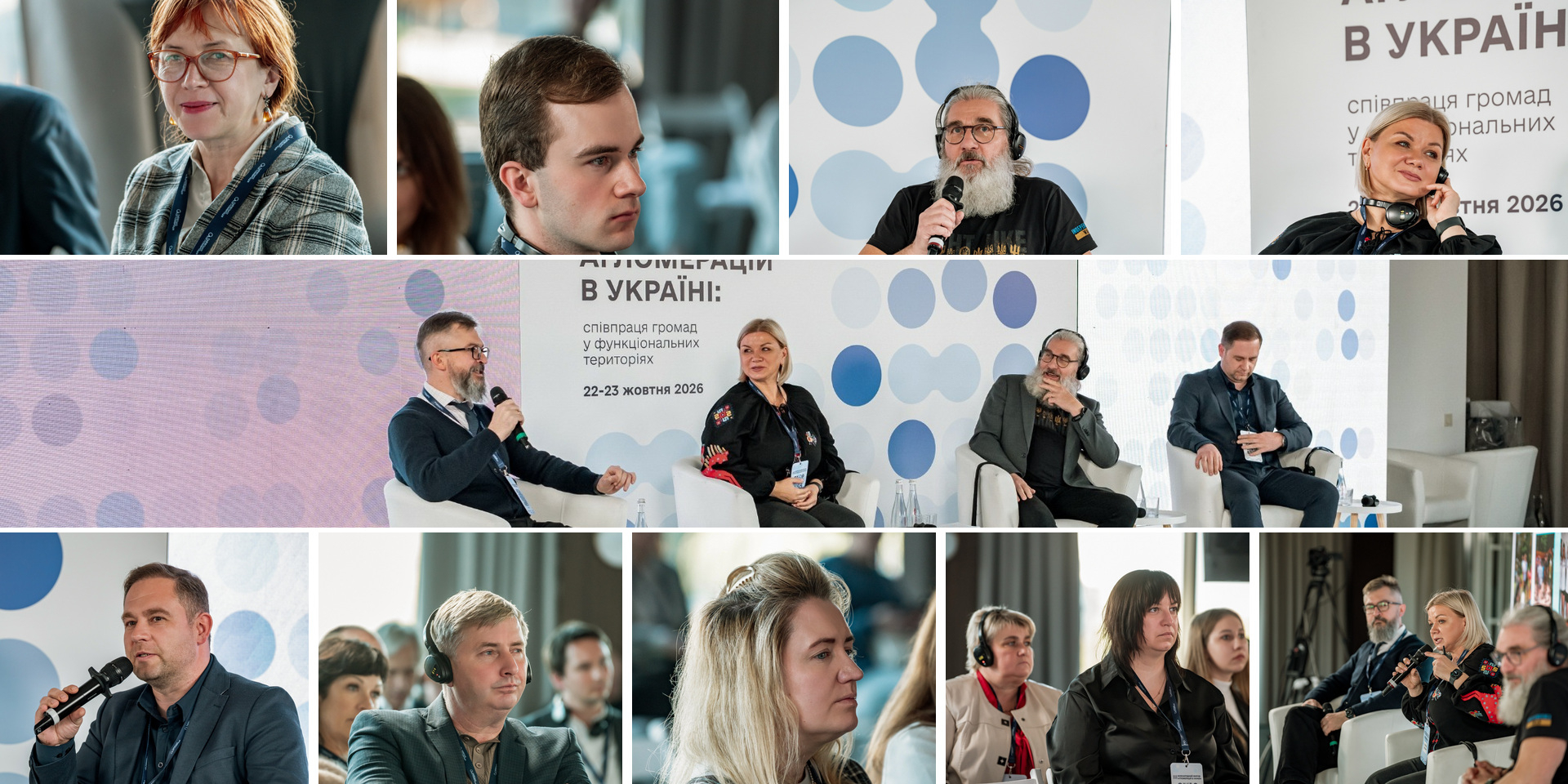
How can communities continue to provide residents with essential services during the war, bring people back, and support those who find themselves in more difficult circumstances? This was the topic of discussion among participants in the panel “Community Resilience: Stronger Together” at the III International Forum of Agglomerations in Ukraine.
The discussion was moderated by Oleksandr Kobzarev, Executive Director of the Unbroken Charitable Foundation. The participants spoke about partnerships between Ukrainian communities and international municipalities, mutual support, and the ability of local authorities to adapt to new circumstances.
Resilience is the ability to adapt
Magnus Liljeström, Advisor to the Cities4Cities | United4Ukraine initiative and Expert at SALAR International, cited the example of Swedish municipalities that have been cooperating across different areas for decades. According to him, partnerships begin with trust and, over time, help communities use resources more effectively and solve problems together.
He also emphasised that such cooperation has to be reciprocal. Ukrainian communities share their experience of working in wartime conditions with their Swedish counterparts, whereas Swedish partners share best practices, particularly in energy efficiency. According to Magnus Liljeström, the Ukrainian experience helps municipalities in Sweden to prepare for crises.
‘Resilience is not about endurance, but about the ability to adapt to new conditions,’ he said.
Savyntsi community: Restoring services and bringing people back
Oksana Suprun, Head of the Savyntsi Settlement Military Administration in Izium district, Kharkiv region, spoke about the work of the frontline community. Before the full-scale invasion, around 10,500 people lived in the community. After the occupation, around 2,000 remained; according to Oksana Suprun, 6,000 residents have now returned.
The community has been restoring housing and social infrastructure so that people have somewhere to return to and can access essential services. By April 2023, the medical infrastructure had been restored and the provision of primary healthcare resumed. To maintain contact with those who had left, the community surveyed 3,500 displaced residents to find out what was needed for their return.
A separate focus was on ensuring children’s safety at school. The community built an underground school with an area of 1,350 square metres and capacity for 400 children. Partner communities also provided support: in particular, they donated equipment for the school and supported joint educational and children’s projects.
‘For me, resilience is about people,’ said Oksana Suprun. She emphasised that, for the community, partnership is not just about memoranda, but also about human relationships and the confidence that, in a crisis, the community will not be left to face its problems alone.
According to her, Savyntsi community has over 100 partnerships with international, national, and local organisations and communities. The cooperation covers infrastructure reconstruction, support for children, education, culture, and assistance to residents.
Obroshyne community: Local services and support from partners
Ivan Halych, Head of Obroshyne community and a member of the General Assembly of the Association “Lviv Agglomeration”, spoke about the experience of Lviv region. One example of the community’s cooperation with German partners is the volunteer fire brigade. According to Ivan Halych, it has already responded to 47 incidents, including dealing with the aftermath of russian attacks and providing first aid. Members of the brigade underwent training in Germany, and the community is currently in talks to establish a fire safety centre.
Partnerships also help to support other communities. Obroshyne community donated heat pumps to the Resilience Centre of the relocated Dolmativka community, and hosted children from the Vilkhivka community in Kharkiv region for a holiday. Such cooperation, according to Ivan Halych, provides an opportunity not only to receive assistance, but also to share resources and experience.
Cooperation as a practical tool
In the final part of the panel discussion, the participants spoke about how resilience is built through concrete action: restoring services, preparing for evacuation, mutual support amongst specialists, and joint projects. Magnus Liljeström called for the development of partnerships that bring practical benefits to both sides. Oksana Suprun emphasised the importance of maintaining contact with people who have left. Ivan Halych urged communities not to delay cooperation, but to make use of the tools already in place.
The III Forum of Agglomerations of Ukraine was organised by the Lviv Agglomeration Association and Lviv City Council, in cooperation with and with the support of the Congress of Local and Regional Authorities of the Council of Europe and the RELEVE project (Expertise France), which forms part of the U-LEAD with Europe programme.
05 November 2026
Municipal Enterprises Reform: Polaris Programme...
The Polaris Programme “Supporting Multi-level Governance in Ukraine” has announced the selection results for...
05 November 2026
RESILIENT COMMUNITIES training programme completed!
RESILIENT COMMUNITIES training programme...
On 5 November, International Project Manager Day, the “Resilient Communities” training programme – developed by...
05 November 2026
Як розвивати співпрацю громад України та Румунії: висновки з Rebuilding Ukraine 2026
Як розвивати співпрацю громад України та...
Джерело - Facebook New Strategy Center Традиційно міжнародне муніципальне партнерство з Румунією є більш...
05 November 2026
Open Call for Experts to Conduct Technical...
The Polaris Programme: Support to Multi-Level Governance in Ukraine invites experts to submit their CVs for inclusion...