Education for community resilience: Legal barriers that need to be removed
The reform of specialised senior secondary schools, the use of the property belonging to educational institutions, vocational training for restoration, and the rules governing the operation of frontline communities – these issues require further legislative solutions. It is on these that it depends whether communities will be able to develop an education network as a tool for regional development, rather than merely maintaining it under conditions of constant restrictions.
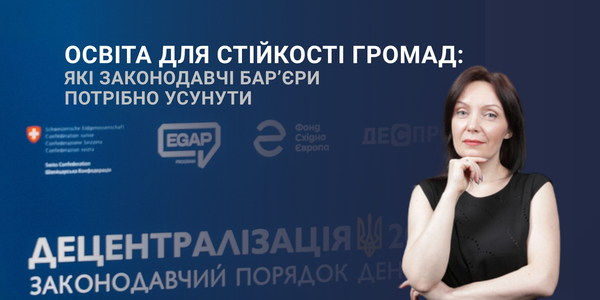
Yana Brusentsova, Expert of the Swiss-Ukrainian project “Decentralisation for Improved Democratic Education” (DECIDE), explained this during the “Decentralisation 2026: Legislative Agenda” forum.
Communities are preparing for specialised secondary education
Yana Brusentsova explains that DECIDE Project works with communities in all regions of Ukraine. Most of them have already formulated a vision for the future network of lyceums and general secondary schools and are preparing to introduce specialised secondary education from 1 September 2027.
At the same time, in the course of this work, communities face issues that cannot be resolved solely through local administrative decisions.
One such issue is the restrictions on the use of the property of educational establishments. Once optimised or transformed, some of these premises may no longer be used for educational purposes; however, the current provisions of the Laws “On Education” and “On Comprehensive Secondary Education” significantly limit the communities’ ability to administer this property.
‘A large number of local governments have approached DECIDE Project with enquiries about how, as things stand today, they might attempt to use property that is not serving educational purposes. And, unfortunately, we can confirm that certain barriers do exist.’
The expert believes that these issues need to be addressed, in particular so that communities can consider the possibility of transferring such assets to investors through public-private partnership mechanisms.
Vocational education should meet the needs of recovery
Yana Brusentsova focused on vocational education in particular. The adoption of the Law “On Vocational Education”, she said, had given this sector a fresh start. However, the legislation requires further refinement.
This concerns the ability of regions and communities to quickly form regional training requirements in cooperation with local and relocated businesses, as well as to introduce flexible retraining programmes.
‘We realise that we are currently placing the greatest emphasis on those new professions that need to emerge in order to restore our country in the future.’
Frontline communities require specific solutions
Yana Brusentsova described the situation of communities located close to the front line or under occupation as particularly challenging. She noted that there is no official legal status for frontline communities in Ukraine, although such communities face a multitude of legal conflicts on a daily basis, particularly in the context of labour relations.
Community leaders and heads of educational institutions, she said, have to determine how to lawfully suspend employment contracts with staff. This issue is raised very often by communities in the occupied regions of Luhansk, Donetsk, and, to some extent, Zaporizhzhia.
‘Certain amendments to the legislation need to be adopted as soon as possible so that these issues can be resolved and to prevent any potential legal disputes from arising later on, which would be directed at the local authorities.’
State financial support also requires a separate approach. In frontline communities, tax revenues are falling dramatically and infrastructure is destroyed, yet they still have to maintain educational institutions and provide people with essential services.
‘A separate, differentiated approach is needed here, including in the calculation of financial support.’
The expert believes that a combination of education reform, the removal of property-related barriers, more flexible rules governing labour relations in war-affected communities, and predictable funding can strengthen the capacity of regions and local self-government.
Read more about the general legislative agenda, outlined during the forum by representatives of the Parliament, the Government, and international partners, in the article “Delineation of powers, community resources and rules for frontline territories: Legislative agenda of decentralisation”.
Read more about the findings of a survey of community leaders on legislative priorities in the article “Remuneration, personal income tax, and legitimacy of councils: What community leaders named as legislative priorities”.
Read more about the staffing capacity of communities, administrative services, and the legislation on administrative fees in the article “Administrative Service Centres start with people: What communities need for quality administrative services”.
Read more about the powers of local councils, military administrations and special rules for frontline territories in the article “How to retain the legitimacy of local councils during wartime and regulate the functioning of frontline communities”.
Read more about the involvement of local government associations in law-making and their proposals for strengthening the resource base of communities in the article “Local government associations: Draft laws to be developed with communities, and resources to remain locally”.
Read more about Anatolii Tkachuk’s approaches to reforming the system of planning and financing regional development in the article “Four steps to effective regional policy: Anatolii Tkachuk’s approaches”.
Read more about Ukraine’s preparations for the EU cohesion policy in the article “EU Cohesion Policy: Ukraine needs not only laws, but a system of governance and partnership”.
Read more about data, digital tools, and the role of regional development agencies in the article “Data, agencies, and people: What transforms regional policy into action in communities”.
Source:
Портал "Децентралізація"
23 September 2026
Медичне відновлення громад: проєкти, партнерства та можливості фінансування
Медичне відновлення громад: проєкти,...
30 вересня – 1 жовтня у Києві відбудеться конференція ReBuild Ukraine: Health & Rehabilitation 2026, присвячена...
23 September 2026
Locally-led Recovery: Polaris Programme Announces 8 Partner Hromadas
Locally-led Recovery: Polaris Programme...
The Polaris Programme “Supporting Multi-level Governance in Ukraine” has announced the selection results for...
23 September 2026
Від реагування до готовності: що потрібно громадам для безпечного водопостачання під час криз
Від реагування до готовності: що потрібно...
Генератор, резервна свердловина чи запас реагентів самі по собі ще не означають, що громада готова до водної кризи....
22 September 2026
Capacity building and empowerment of local communities in Ukraine
Capacity building and empowerment of local...
This article of the U-LEAD series identifies the additional and strengthened capacities that Ukrainian local...