Remuneration, personal income tax, and legitimacy of councils: What community leaders named as legislative priorities
Decent remuneration for local government officials, increasing the share of personal income tax in local budgets, and more opportunities to manage assets and administer local taxes – these are the main legislative priorities identified by local leaders.
The results of the study “Decentralisation 2026: Research on the Priorities of the Legislative Agenda” were presented by Oleksii Vernik, an expert of DESPRO NGO, during the “Decentralisation 2026. Legislative Agenda” forum.
The research consisted of two parts: participants assessed the main challenges in the work of local governments and determined the significance of legislative initiatives for the 16th session of the Verkhovna Rada of Ukraine of the 9th convocation.
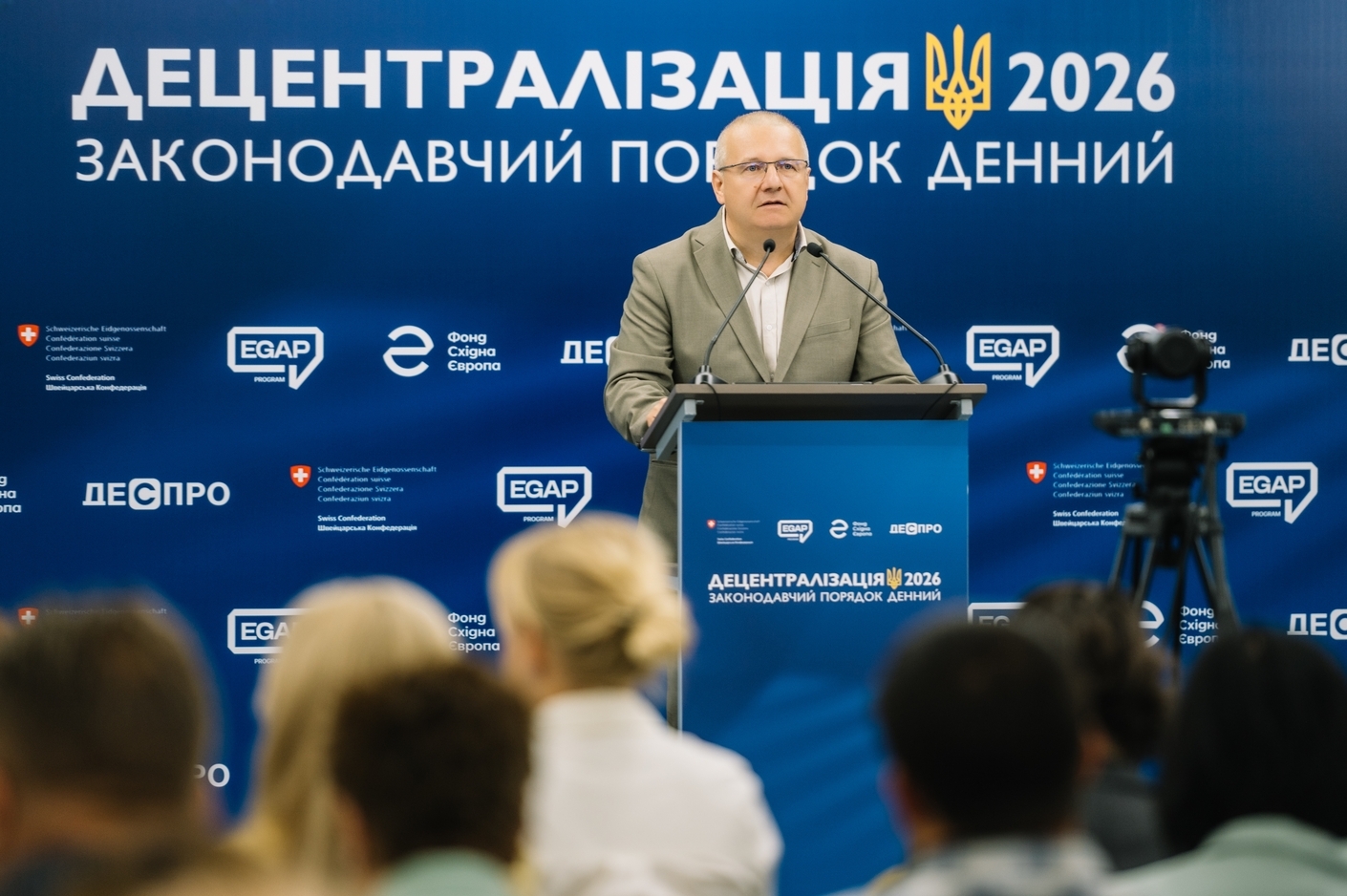
‘The current research aims to find out the position of local governments regarding the priorities for considering draft laws that relate to their activities. The views of local government leaders on 31 legislative initiatives were examined,’ said Oleksii Vernik.
DESPRO NGO has been conducting such research jointly with its partners since February 2023. This is the seventh national research project on the legislative agenda for decentralisation. The majority of its participants have significant practical experience: 55% have held leadership positions for over five years, and 51% have more than ten years’ service in local governments.
Human resources – the first legislative priority
The amendments to the Law “On Service in Local Governments” regarding the provision of decent remuneration for local government officials received the highest score in the ranking of legislative initiatives. 68% of respondents identified these as a priority.
This result is directly linked to the staffing situation in communities: 80% of respondents consider low official salaries to be a problem in motivating qualified specialists to work in local governments. Only 13% do not consider this to be a problem.
‘Of all the questions in the questionnaire, this one had the lowest proportion of those who were undecided – just 7%. In other words, the problem of motivating qualified staff due to low salaries is very clear for communities,’ noted Oleksii Vernik.
A further 55% of respondents reported a shortage of jobs in their communities. Among the factors that hinder the effective operation of utility companies, respondents named outdated infrastructure, low purchasing power amongst the population, and staff shortages.
Financial capacity: Personal income tax, local taxes, and property
The second most significant initiative was the amendments to the Budget and Tax Codes regarding an increase in the share of personal income tax allocated to local budgets. These were supported by 63% of respondents.
The problem of ensuring the financial capacity of local governments was reported by 64% of respondents. At the same time, 65% of those surveyed had consistently allocated funds from their own budgets to support the Armed Forces of Ukraine over the past year, whilst for 29% of all respondents, the amount of such support exceeded 10% of the community budget.
Third in the ranking was the legislative initiative to expand the powers of local governments in the management of state or municipal property – 59% of the respondents identified this as a priority.
Next came changes to the procedure for paying personal income tax at the place of residence or its allocation between the place of work and the place of residence – 57%. A further 52% of respondents ranked changes that would grant local governments additional powers to administer local taxes and charges as a priority.
The research also revealed that the current state of tax administration is a concern for communities. According to 44% of respondents, tax authorities do not properly fulfil their functions in administering local taxes and charges, whilst another 44% cited the non-taxation of immovable property, in particular land plots. Among the reasons for non-taxation, 34% of respondents mentioned unresolved property issues, whilst 28% cited a lack of data in state registers.
Regarding the model for paying personal income tax (PIT), 84% of respondents chose options involving payment of the tax at the place of work. Only 16% supported the allocation of PIT at the individual’s place of registration.
Powers, legitimacy of councils, and wartime legislation
Problems in the delineation of powers between military administrations of localities and local governments were reported by 46% of respondents. A further 42% see a problem in the delineation of powers between local governments at different levels of the administrative-territorial structure.
The top ten legislative priorities also include:
- amendments to the Budget Code regarding local governments’ support for the security and defence sector – 50%;
- a draft law on ensuring the legitimacy of local councils under martial law – 47%;
- amendments regarding the organisation of labour relations in territories affected by hostilities and temporarily occupied territories – 47%;
- a draft law on administrative fees – roughly 40%;
- the Urban Planning Code of Ukraine – 39%.
Thus, community leaders surveyed identify as priorities decisions relating to the everyday operation of local governments, the financial foundations of communities, and working in the conditions of war.
Development challenges: From urban planning to energy and education
In urban planning, 46% of respondents identified a lack of financial support as the main obstacle to development and the drafting of urban planning documentation. Poor legislative regulation was cited as the main factor by 22%.
In international, inter-regional, and inter-municipal cooperation, the greatest barrier for communities is insufficient human resources – this was highlighted by 33% of respondents. Difficulties specifically with international partnerships were reported by 38%.
For proper energy supply and the development of power generation in communities, respondents listed the limited capacity of local power generation as the main problem – 35%. The lack of state support for such projects was mentioned by 20%, whilst 19% referred to significant damage to facilities caused by shelling.
Respondents also commented specifically on the modernisation of the education system. Of those surveyed, 53% supported legislative regulation that takes into account the real challenges and particularities of different regions: 31% favoured this based on the particularities of a specific region, whilst a further 22% supported it through dialogue between local and central authorities.
According to Oleksii Vernik, the research results show not merely a list of communities’ wishes, but the link between their everyday problems and the legislative solutions they expect. Remuneration, financial resources, tax instruments, the legitimacy of councils, and a clear delineation of powers between different levels of authority are all elements of a community’s capacity to operate, deliver services, maintain security, and plan for development.
For more details on the position of the Parliament, the Government, and international partners, read the publication “Delineation of powers, community resources and rules for frontline territories: Legislative agenda of decentralisation”.

Source:
Портал "Децентралізація"

04 September 2026
Виховати своїх фахівців, аби не шукати чужих....
Глеюватська громада на Дніпропетровщині розташована всього в 15 хвилинах від міста Кривий Ріг. Для багатьох це...
04 September 2026
«Освітнє Полісся 2026/27: Навчаємо. Надихаємо....
20 серпня у Житомирі відбувся Серпневий форум «Освітнє Полісся 2026/27: Навчаємо. Надихаємо. Перемагаємо», який...
04 September 2026
Анонс: вебінар «ПКМУ №527, що змінилося у...
У серпні 2026 року Уряд вніс важливі зміни до системи управління публічними інвестиціями. Тому I_CAN спільно з...
04 September 2026
Рада є, а впливу не видно. Що заважає...
АВТОР - Володимир Серветник - експерт із публічного врядування та ветеранської політики, PhD з публічного управління...