Adaptive model for activities of local state administrations: New approaches to structure, employee numbers, and remuneration
The current model for activities of local state administrations has become less and less suited to the conditions under which the state operates nowadays. After the administrative-territorial reform and in the context of a full-scale war, executive authorities perform tasks that are diverse in nature and complexity: some ensure operations in frontline territories, others are preparing for the restoration of de-occupied communities, whilst still others are responsible for implementing state policy in rear regions. At the same time, the approaches to their structure, employee numbers, and organisation of work remain unchanged.
Therefore, the Ministry for Development of Communities and Territories of Ukraine has developed a concept for an adaptive model for the activities of local state administrations. It provides for differentiated approaches to structure, maximum employee numbers, staffing, and remuneration, depending on the security status of the territory, the demographic situation, the actual workload, and the scope of powers.
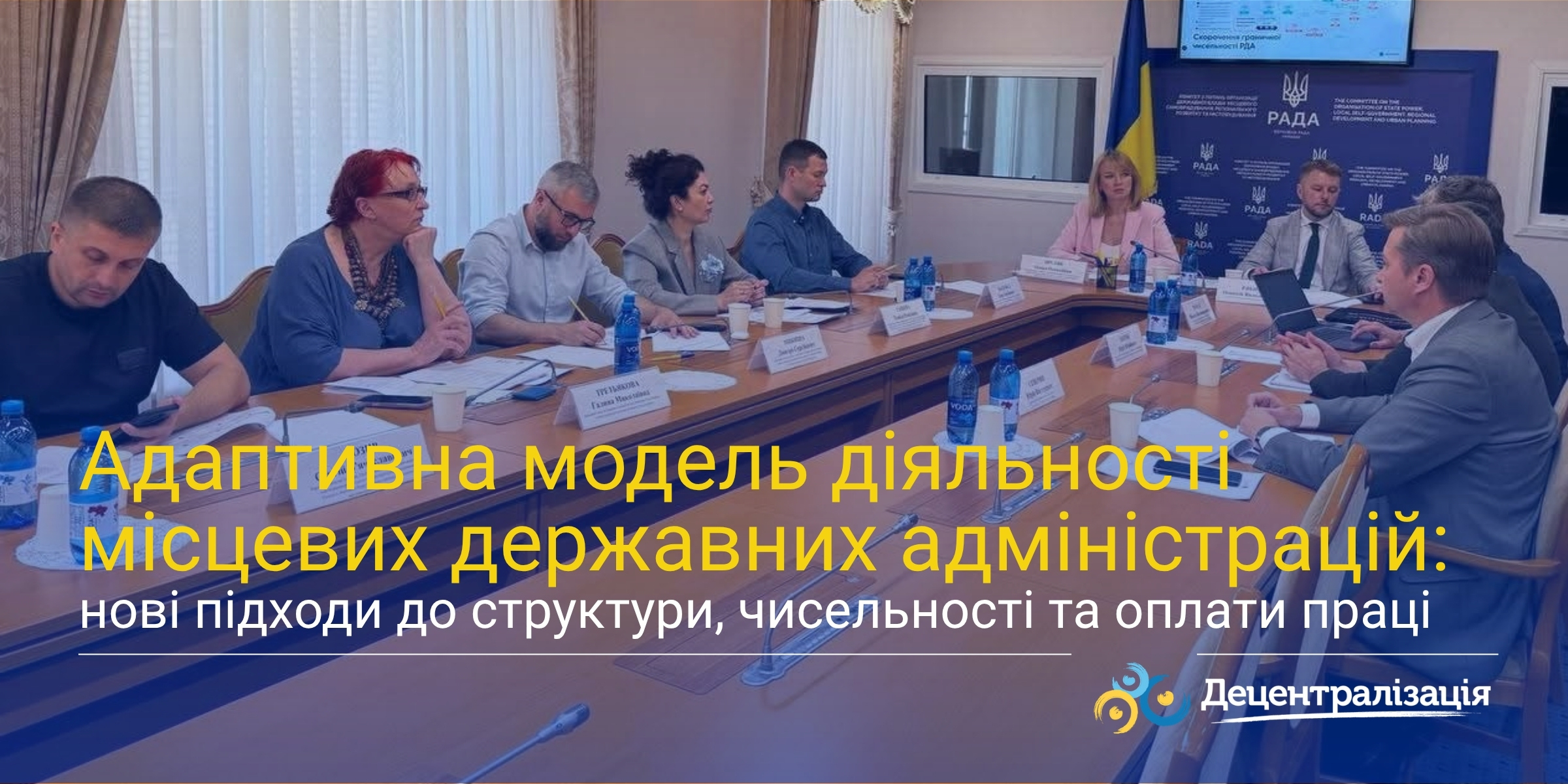
These proposals were discussed during the round-table discussion “Adaptive Model for the Activities of Local State Administrations: New Approaches to Structure, Employee Numbers, and Remuneration”, organised by the Verkhovna Rada Committee on the Organisation of State Power, Local Self-Government, Regional Development and Urban Planning, in cooperation with the Ministry for Development of Communities and Territories of Ukraine.
The participants in the discussion focused on what the model for local state administrations should look like in the context of war and post-war restoration, what functions they should perform in different types of territories, what criteria should be used to determine their staffing levels, and how to establish a fair system of remuneration for civil servants.
From a standardised to an adaptive model
Opening the discussion, Olena Shuliak, Chair of the Verkhovna Rada Committee on the Organisation of State Power, Local Self-Government, Regional Development and Urban Planning, pointed out that the changes have to take into account the fundamentally different conditions under which local state administrations currently operate.
According to Ms Shuliak, the new model should abandon the standardised approach to the activities of local state administrations and take into account the real conditions in which they operate. Hence, this is not about formal optimisation, but about developing a new approach to organising their work.
‘We need to develop a new vision for the activities of local state administrations, particularly for rear, frontline, de-occupied, temporarily occupied, and partially occupied territories. The security status of the territory, the demographic situation, the varying scope of administrative tasks, and the actual workload on each administration are important factors to take into account as much as possible. This also concerns the functional workload, staffing levels, and remuneration issues,’ noted Olena Shuliak.
She emphasised that the proposals prepared by the Ministry for Development of Communities and Territories will form the basis for a professional discussion, and that the suggestions put forward by the participants should be taken into account during the further improvement of the model.
Oleksii Riabykin: The focus of the reform has to be on people
Oleksii Riabykin, Deputy Minister for Development of Communities and Territories of Ukraine, reported that work on the adaptive model had taken nearly a year, in response to a directive from the Prime Minister of Ukraine.
He stressed that the discussion about the future of local state administrations cannot be reduced solely to matters of structure or staff reductions.
‘I want to ask everyone to reflect on a few important points. In my view, a civil servant should not feel deprived. In my view, a civil servant should feel protected by the state. A civil servant must understand their responsibilities and perform their duties to a high standard. And a civil servant must be respected by society. Why? Because a country is made up of its people and its territory. The state is made up of civil servants. That is you and me. We shape its policy through laws, strategies, and resolutions of the Cabinet of Ministers. I would therefore ask that the issue of optimising any structures – not just local state administrations – be considered precisely in this context,’ said Oleksii Riabykin.
According to the Deputy Minister, the necessity to revise the model of local state administrations stems not only from digitalisation and changes to governance processes, but also from the fact that different regions of the country currently operate under fundamentally different conditions.
‘Ukraine is a very large country, with very diverse territories. There are frontline territories, central territories close to the frontlines, and western territories, which are currently least affected by the challenges of war. But the state has to respond to this diversity and introduce specific approaches and a specific structure to take into account the needs of the people in these regions and the specific issues that these regions face,’ emphasised Oleksii Riabykin.
The Deputy Minister also pointed out that the proposed changes have to be considered in the context of Ukraine’s European integration. According to Mr Riabykin, local state administrations are already receiving new responsibilities that involve supervising the legality of decisions made by local governments, strengthening coordination between the territorial bodies of central executive authorities, and implementing cohesion policy, which is one of the key mechanisms for the development of regions in the European Union.
He urged the participants to engage as actively as possible in improving the proposed model, emphasising that the Ministry for Development is interested in professional suggestions from representatives of local state administrations, who work daily in a variety of security and administrative conditions.
Why the current model no longer meets modern requirements
The concept of an adaptive model for the activities of local state administrations was presented by Mykola Rubchak, Director of the Department of Multi-Level Governance at the Ministry for Development of Communities and Territories of Ukraine.
According to him, the system of local state administrations currently operates under a model that was established as far back as 1999 and has not undergone a comprehensive revision since then. Since then, Ukraine has completed its administrative-territorial reform, the system of local self-government has changed significantly, the number of local councils has been reduced, and a full-scale war has presented fundamentally new challenges for the state.
‘The system of local state administrations currently operates in the form in which it was established back in 1999 and does not take into account the fundamental changes that have taken place in the country since then. We have completed the reform of the administrative-territorial structure, established a new system of communities and a new district level. The number of local councils has decreased from 11,590 to 1,470. Moreover, the full-scale armed aggression by the russian federation has presented the country with new tasks and reoriented the activities of local state administrations not only to perform civilian functions but also to meet wartime needs,’ remarked Mykola Rubchak.
Therefore, according to the Director of the Department, isolated changes are insufficient nowadays. A comprehensive revision of the approaches to organising the work of local state administrations is necessary.
‘We propose transitioning to a differentiated model for the activities of local state administrations and defining separate approaches for rear, frontline, and temporarily occupied territories at both regional and district levels,’ he said.
Three types of administration instead of a standardised approach
The model proposed by the Ministry for Development envisages that the structure of local state administrations will be determined according to the security status of the territory. For the regional and district levels, it is proposed to develop separate recommended models for rear territories, frontline territories, and temporarily occupied territories.
At the same time, the basic principle governing the structure of the administrations remains the same. It is proposed that their activities be organised into three main sections:
- units responsible for the exercise of executive power;
- units that perform specific powers of local governments;
- specialised units whose activities are defined by legislation, including in the areas of anti-corruption policy, coordination of territorial bodies of central executive authorities, protection of children’s rights, and archival affairs.
According to Mykola Rubchak, taking into account the latest legislative changes, the Ministry for Development proposes refocusing the activities of the administrations primarily on ensuring the legality of acts issued by local governments, coordinating the work of territorial bodies of central government, defence, civil protection and other functions that have become highly relevant during the war.
Different territories – different priorities
It is proposed that rear territories retain a wide range of functions connected with the implementation of state policy. In particular, these include economic development, investment, international cooperation, auditing, social protection, regional policy, digitalisation, defence, civil protection, critical infrastructure protection, and veterans’ policy. Local state administrations will also retain certain powers in the areas of finance, urban planning, education, healthcare, culture, transport, and housing and utility services.
For frontline territories, the model provides for the strengthening of functions related to security, defence, civil protection, cooperation with law enforcement agencies, restoration of territories, and ensuring the functioning of communities. At the same time, it is proposed that certain areas of activity be adapted to the conditions of a constant security threat.
The model for the activities of local state administrations in the temporarily occupied territories will undergo the most significant changes.
According to Mykola Rubchak, as it is impossible for them to exercise their powers directly in their own territory, it is proposed that their activities be refocused on performing other state tasks.
‘For the temporarily occupied territories, we propose that the activities of local state administrations focus on supporting internally displaced persons, documenting the aftermath of the occupation, working with the population that remains in the temporarily occupied territories, engaging with the communities to which their residents have relocated, as well as preparing for de-occupation and the restoration of state authority,’ he remarked.
Moreover, it is proposed that the administrations of the temporarily occupied territories retain their functions in the areas of economic development, international cooperation, digitalisation, defence and law enforcement cooperation, internal audit, as well as the specialised units specified by law.
According to Mykola Rubchak, the next element of the proposed model should be a fundamentally new approach to determining the maximum number of employees in local state administrations. The next part of the presentation was devoted to this very topic.
A new approach to determining the number of employees in local state administrations
A separate section of the presentation by the Ministry for Development of Communities and Territories was devoted to determining the maximum number of employees in local state administrations. As Mykola Rubchak stated, the current system no longer reflects the actual workload on the administrations, as it was established prior to the administrative-territorial reform and the full-scale war.
He said that the Ministry for Development is proposing a change from standardised norms to a transparent formula that will take into account the specific characteristics of each territory.
‘We propose abandoning the existing approaches and determining the number of employees in administrations using a clear methodology that takes into account not only the administrative-territorial structure but also the actual workload on local state administrations,’ said Mykola Rubchak.
The proposed methodology provides that the number of administrative staff will consist of two parts: a core component, necessary to ensure the performance of the state’s key functions, and an optional component, which will be determined according to the specific characteristics of a particular territory.
The indicators proposed for consideration in the calculation include the area of the territory, the population, the number of communities, districts and internally displaced persons, as well as other factors that directly affect the workload of local state administrations. It is proposed that specific coefficients be applied to territories affected by armed aggression.
According to Mykola Rubchak, the proposed model should be flexible and allow for the employee number of administrations to be reviewed in case of changing circumstances.
‘The model has to respond to changes. If the administrative-territorial structure, the population size, the security situation or the functions of local state administrations change, this has to be automatically taken into account when determining their size,’ he explained.
At the same time, the Director of the Department emphasised that the proposed changes are not intended to result in a mechanical reduction in the number of employees.
‘We are not proposing a reduction or increase in employee numbers as a goal in itself. We are proposing rules – clear, transparent and the same for everyone. These rules should determine how many people are needed to perform particular functions of the state,’ said Mykola Rubchak.
MPs: The model needs to be improved, based on experience in frontline and de-occupied territories
In general, the participants of the discussion supported the necessity of the transition to an adaptive approach, but emphasised that certain elements of the concept need to be improved, taking into account the practical experience of local state administrations working in wartime conditions.
Member of the Ukrainian Parliament Serhii Kozyr, who headed the Kherson Regional State Administration for a long time, stated that the classification of territories proposed by the Ministry for Development is logical, but fails to take into account another category – de-occupied territories, which face fundamentally different challenges to those in the rear or frontline regions.
According to the MP, after the liberation of territories, local state administrations practically begin their work in conditions of an almost complete lack of administrative infrastructure. Therefore, different functions and a different approach to staffing should be defined for them.
He referred to Kherson after de-occupation as an example, noting that only the head of the administration and his two deputies had returned to the city, whilst the majority of employees were in other regions of the country.
According to the MP, the main tasks for administrations in de-occupied territories should be the rapid restoration of the work of public authorities, the attraction of investment and human resources, the restoration of infrastructure, and the creation of conditions for the return of the population.
Serhii Kozyr also paid attention to the need to retain the human resources of the administrations in the temporarily occupied territories.
‘We simply will not be able to bring people back. It is the identity of the community, the work with internally displaced persons, and the resumption of operations by relocated enterprises. This needs to be approached very carefully,’ he emphasised.
The main criterion for the reform is the efficiency of administrations
Ukrainian MP Ihor Vasyliev, who represents the border Sumy region, emphasised that the key outcome of the proposed changes should not be a review of staffing levels, but an improvement in the efficiency of local state administrations.
According to the MP, border regions already face a brain drain, with civil servants having to work under constant shelling, whilst their salaries do not always reflect the conditions in which they perform their duties.
‘The most important point is that, once the reform is complete, we end up with effective bodies. We have to ensure that people want to work there,’ said Ihor Vasyliev.
He also proposed revising the funding mechanisms for district military administrations in frontline regions. In particular, in his view, it would be reasonable to allow not only funds from local budget surpluses to be channelled to their activities, but also the reserve fund and unallocated balances.
Additionally, the MP drew attention to the importance of revising the structure of certain departments whose functions, following the reform of local self-government, are partly duplicated or have already become obsolete.
Tamila Tasheva: Full-scale war has confirmed the need for an adaptive model
Ukrainian MP Tamila Tasheva supported the concept presented by the Ministry for Development, stating that similar principles have long been under consideration by a working group of the Verkhovna Rada Committee on the Restoration of State Authority and Local Self-Government in the Temporarily Occupied Territories.
According to the MP, the full-scale war has confirmed that a standardised model for the activities of local state administrations no longer meets the real needs of the state.
She stated that the rear regions currently focus on implementing development policies and supporting the economy, whilst frontline and temporarily occupied territories operate under entirely different conditions and require a different organisation of public administration.
The MP paid special attention to the activities of the administrations in the temporarily occupied territories. In her view, these administrations should not only maintain contact with communities and prepare for de-occupation, but also strengthen the international dimension of their work.
The activities of military administrations also need reassessment
Dmytro Mykysha, Member of the Ukrainian Parliament, joined the discussion, drawing attention to the fact that, whilst improving the model, the specific nature of the activities of military administrations should be taken into account.
According to the MP, military administrations currently exercise a much broader scope of powers than was envisaged before the outbreak of full-scale war; therefore, the proposed changes should reflect present-day practices in public administration.
Dmytro Mykysha also emphasised that one of the key functions of local state administrations remains the coordination of the activities of the local executive bodies of Central Government. In his view, this function in particular should be more clearly reflected in the new model, as it ensures the coordinated work of state bodies at the local level.
Halyna Tretiakova: Different models should provide for different approaches to funding
The participants devoted much attention to the question of funding for the future model.
Halyna Tretiakova, Chair of the Verkhovna Rada Committee on Social Policy and the Protection of Veterans’ Rights, supported the idea of differentiating between local state administrations, but insisted that different types of administration should be assigned not only different functions but also different approaches to funding.
‘Whatever we talk about, it comes to money. Therefore, all our discussions ultimately reduce to what the budget formula will be,’ commented Halyna Tretiakova.
She supported the proposed approach to determining the employee number of local state administrations, but noted that the formula should take into account the actual workload on the administrations as objectively as possible.
According to the MP, it is important to correctly define the set of indicators that will influence employee numbers, given that the area of the territory or the size of the population alone do not always reflect the complexity of governing a particular region.
Remuneration should be based on functions, not on the number of bonuses
The matter of remuneration for civil servants has become a separate topic of discussion.
Oleh Voitovych, Acting Head of the National Agency of Ukraine on Civil Service, emphasised that any changes ought to begin not with a system of allowances or bonuses, but with a clear definition of the functions of the public authority.
In his view, the functions themselves determine the structure of the administration; the structure, in turn, determines the necessary number of staff; and only then can a modern remuneration system be established.
‘The structure is built on the functions. The staffing table depends on the structure. And only after that can we talk about remuneration – which should be adequate, fair, and motivating people to work effectively,’ said Oleh Voitovych.
He also noted that the state should finally abandon the practice whereby the bulk of a civil servant’s income consists of numerous allowances.
‘For one person, 100 percent of bonus; for another, 300; for yet another, 20. This cannot be acceptable. And it will not be like this any longer,’ noted Oleh Voitovych.
In his view, the new model should ensure a transparent and comprehensible remuneration system that is equally clear to both civil servants themselves and the public.
Legislative amendments are necessary to implement the model
Yurii Severyn, Director of the Department of Regional Policy at the Secretariat of the Cabinet of Ministers of Ukraine, drew attention to the fact that implementing the proposed model will require not only government resolutions but also amendments to legislation.
According to Mr Severyn, work on amendments to legislation and subordinate legal acts should be synchronised from the very outset to avoid legal conflicts.
‘I would prefer that we proceed along a parallel track. Because when we come to drafting government resolutions, we may find that the necessary terminology is not yet in place in the legislation,’ observed Yurii Severyn.
This refers, in particular, to the legislative definition of specific categories of territories on which the proposed adaptive model is based.
At the same time, he supported the approach proposed by the Ministry for Development and emphasised the need for its further improvement in cooperation with all stakeholders.
Further discussion is planned
Summing up the discussion, the participants agreed on the necessity of transitioning to an adaptive model for the activities of local state administrations. However, they suggested to further improve certain elements of the concept, particularly those concerning the activities of administrations in de-occupied territories, the functioning of military administrations, the methodology for determining staff numbers, approaches to funding and the remuneration system.
The Ministry for Development of Communities and Territories is to review the proposals put forward during the round-table discussion in cooperation with the relevant Parliamentary Committee, representatives of local state administrations, and the expert community. It is expected that, based on the results of this work, the necessary amendments to legislation and government resolutions will be drafted, which are to form the basis for the implementation of an adaptive model for the activities of local state administrations.
Source:
Портал "Децентралізація"
14 July 2026
Олексій Марченко: «Не сумніваюся у тому, що до нас повернеться 90% наших мешканців…»
Олексій Марченко: «Не сумніваюся у тому, що до...
Начальник Лазурненської селищної військової адміністрації Херсонської області Олексій Марченко про громаду, яка...
13 July 2026
Анонс: вебінар «Розширення програми...
До участі запрошуємо представників обласних військових адміністрацій, керівників...
13 July 2026
Відбулася зустріч «Розширення програми...
10 липня відбулася зустріч «Розширення програми безоплатного шкільного харчування з 1 вересня 2026 року: виклики,...
13 July 2026
Cities4Cities Mentorship: results of the first...
Over seven months, ten hromadas strengthened their international capacity, established partnerships with...