Oleksii Riabykin: ‘Cohesion policy does not start with resources, but with the right decisions’
The successful implementation of the approaches of the EU Cohesion Policy depends not only on access to financial instruments, but above all on the quality of strategic planning, coordination, and management of territorial development.
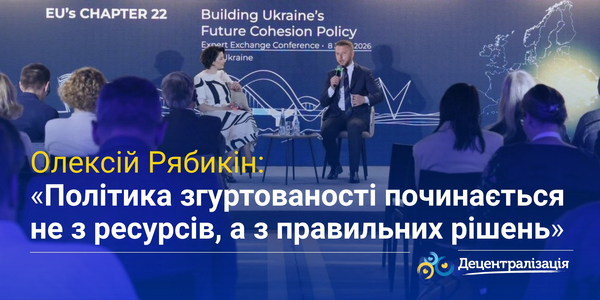
Oleksii Riabykin, Deputy Minister for Development of Communities and Territories of Ukraine, highlighted this during a public interview at the conference “EU Chapter 22: Shaping Ukraine’s Future Cohesion Policy”.
The conference was co-organised by the Ministry for Development of Communities and Territories of Ukraine and U-LEAD with Europe Programme, with the participation of the OECD, the Ministry of Development Funds and Regional Policy of the Republic of Poland, and EU4Reconstruction (Strand 1).
Resources do not determine success
According to Oleksii Riabykin, one of the common misconceptions is viewing the EU Cohesion Policy solely through the prism of future funding.
‘We can and should speak not only about resources. We often hear: resources, the European Union, look how wonderful it is in Poland, how wonderful in Romania, how wonderful in Hungary. But the key here is not the resources. The key here is that these regions and these governments set the appropriate goals for themselves from the very beginning. They agreed, defined the objective, and incorporated this goal into their strategy. This strategy was cascaded down from the central level to the grassroots level. Investment funds were then pooled to support these strategies.’
The Deputy Minister stated that this sequence of actions is exactly what has enabled many EU countries to achieve tangible results in regional development.
‘This is not just about building a road or repairing a school. It is about comprehensive development and solving complex problems.’
He also emphasised that the subject of Section 22 should be discussed much more frequently in Ukraine, as it concerns the quality of people’s lives.
‘This is about how to make a territory comfortable to live in, barrier-free, and economically developed, where people receive high-quality services, have access to quality services, clean water and fresh air, and know how and whom to turn to for help with their problems.’
Coordination remains the weakest element
Oleksii Riabykin highlighted several key components of the work ahead.
‘For me, Chapter 22 is about strategic planning, investment, and the measurability of the results of these investments. Accordingly, there should be a monitoring system. But when it comes to the most important point, it is coordination. Our coordination is very poor. Unfortunately. It should primarily take place at the government and parliamentary levels.’
According to the Deputy Minister, Ukraine needs to develop joint approaches to regional development so that all levels of authority work in a unified manner and towards common goals.
Resources should be used strategically
During the interview, Oleksii Riabykin paid special attention to funding regional development.
In his words, state resources are currently scattered across different programmes and sectors, which often prevents the achievement of a comprehensive outcome.
‘Today we talked about the State Fund for Regional Development. But our resources are scattered. Because every ministry has its own sectoral policy, we end up with a fragmented result. But we would like the results to be systematic.’
Under the current circumstances, he emphasised, this matter is particularly important.
‘At present, the country has very limited resources. Extremely limited resources. Therefore, coordination, coordination, and once again coordination.’
Meanwhile, Ukraine should prepare for future work with European development mechanisms.
‘Before we attract European funds, we need to learn how to work with our own resources. We are still in the process of learning. We are not yet experts in this matter. At present, the State Fund for Regional Development is a very weak element, both in terms of resources and implementation capacity. With two billion hryvnias, I cannot do anything even in Sumy region alone. And there are ten frontline regions.’
From delineation of powers to the Master Plan
One of the key tasks in preparing for negotiations under Chapter 22, the Deputy Minister noted, is the delineation of powers between levels of authority, the improvement of strategic planning, and the reform of public investment management.
‘Each level of authority should have a transparent set of powers at that level, along with the resources to implement them.’
The Ministry for Development is also working on a Master Plan for Chapter 22.
‘These are specific tasks with specific timeframes and specific people in charge. It is, basically, a practical document that outlines how we will implement this.’
Parallel to this, work is ongoing on a new State Strategy for Regional Development.
‘The State Strategy for Regional Development has to transform from a scientific paper into a very specific, concise document that sets out very clear objectives which can be cascaded down to both regions and communities.’
Institutional capacity starts with people
Separately, Oleksii Riabykin emphasised the importance of the human resources capacity of state authorities and local governments.
‘I would like to thank civil servants for doing their jobs and continuing to do it well despite very, very low salaries.’
He believes that people are the foundation of any reform.
‘If a public servant in a local government body or state authority receives a decent salary to perform their duties, I will consider our work a success. If a public servant is respected by society, I will consider that we are fulfilling our mission.’
Other indicators of success he cited include high-quality strategic planning at all levels, the introduction of a regional development monitoring system, the adoption of necessary legislative changes, and the creation of an effective instrument for funding regional development.
Regional Development Agencies and the future of frontline territories
According to the Deputy Minister, Regional Development Agencies are expected to play a key role in the future system of regional development.
‘They are a unique tool designed to connect local governments, state authorities, and private investors. To “revitalise” the region, to attract investment there, and to assist with strategic planning.’
The Ministry is also working on a cluster model for the development of regional development agencies, which should help disseminate best practices across regions.
A special focus is on frontline territories, which face not only destruction but also depopulation and economic challenges.
‘These territories need a recovery process. We need to rethink the mission of these territories and rethink the tools for attracting people to them, because depopulation has practically happened there. We need to consider specific economic models for these territories.’
Source:
Портал "Децентралізація"
17 June 2026
Президент України заснував почесну відзнаку «Громада-рятівник»
Президент України заснував почесну відзнаку...
Президент України Володимир Зеленський підписав Указ №491/2026, яким засновано почесну відзнаку «Громада-рятівник»...
17 June 2026
Фінансовий модуль АІКОМ: представлено новий інструмент для аналізу освітніх видатків
Фінансовий модуль АІКОМ: представлено новий...
15 червня відбулася презентація Фінансового модулю АІКОМ для управлінців у сфері освіти, фахівців та фахівчинь з...
17 June 2026
Проєкт DECIDE оголошує грантовий конкурс на...
Швейцарсько-український проєкт DECIDE запрошує територіальні громади-учасниці національного пілотування системи...
17 June 2026
Як у Кременчуці ламають стереотипи про профтех та будують економіку довіри
Як у Кременчуці ламають стереотипи про профтех...
Ще донедавна це було типове приміщення радянської їдальні – із застарілими вікнами, пошкодженими стінами та духом...