(De)occupied and frontline communities in the context of war and post-war governance
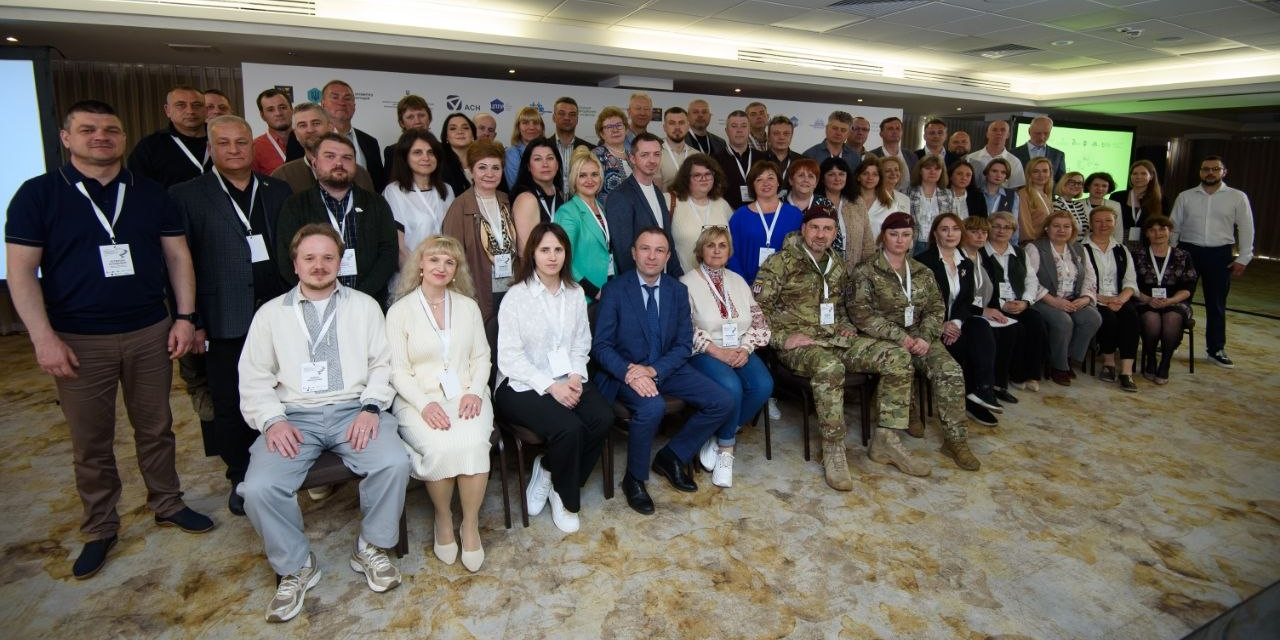
On 19 May, Kyiv hosted the conference ‘(De)occupied and frontline communities in the context of war and post-war governance’, which brought together 150 representatives from central government, military administrations (MAs), local governments, the military, the expert community, civil society organisations, and international partners. The participants discussed what the legislative framework for governing frontline, de-occupied, and temporarily occupied territories should look like during the war and after its end, as well as how to ensure conditions for public engagement in this process. The event turned into a large-scale public debate on what the governance system should look like in territories living under constant security threats, temporary occupation, the relocation of authorities, and the displacement of the population.
The conference has become the third major public debate dedicated to the future governance of de-occupied and frontline territories. Whilst previous years were more of an attempt to outline the scope of the issues and identify key challenges, this year’s discussion focused largely on specific legislative decisions, governance models, and public policy that will shape life in these territories once the active phase of the war has ended.
One of the central topics of the event was the presentation of the key provisions of the draft Law of Ukraine ‘On Amendments to Certain Laws of Ukraine Concerning the Functioning of Public Authorities in Frontline Regions’. The draft law proposes a new model for military-civilian administrations (MCAs) after the termination of martial law as a transitional governance mechanism for territories where it will be impossible to immediately return to a system of civilian governance. The key changes include the transfer of powers to establish the MCA from the President to the Cabinet of Ministers, the creation of public councils under the MCA, new mechanisms for parliamentary and public control, mandatory reporting by heads of administrations to local residents, and specific mechanisms for the functioning of territories where it will be impossible to hold elections even after the active phase of the war has ended.
The discussion during the first panel focused on what legislative measures are required to ensure institutional resilience. The discussion centred on the future model for the functioning of military and military-civilian administrations, state policy with regard to temporarily occupied territories, staffing of the government system, mechanisms for supporting communities, and issues of trust in the state during wartime and after de-occupation.
‘We cannot make decisions at the state level that affect thousands of people without taking all the nuances into account. Therefore, we are currently working on a comprehensive vision for future governance in the de-occupied territories, from legislative changes to the formulation of a unified strategy for the temporarily occupied territories. And I very much hope that as early as next year we will be talking not about concepts, but about specific decisions that have been adopted,’ said Tamila Tasheva, Chair of the Subcommittee on the Restoration of State Authority and Local Self-Government in Temporarily Occupied Territories.
A working group is already working under the relevant committee of the Verkhovna Rada to develop solutions for the restoration of state authority in the de-occupied territories. MP Tasheva also drew attention to the development of a unified strategy for the temporarily occupied territories, which, she said, must be approved at the level of the National Security and Defence Council of Ukraine.
The panellists paid special attention to the formation of a systematic state policy to support territories for restoration and communities that have survived occupation or continue to live near the front line. The discussion focused not only on financial tools, but also on the human resources, institutional and administrative capacity of the state to work with such territories in the long term.
‘Human resources means the law on public service, the training system, and the educational institutions that will staff these bodies with people who want to make change,’ emphasised Yurii Severyn, Director of the Department of Regional Policy at the Secretariat of the Cabinet of Ministers of Ukraine.
Mykola Rubchak, Director of the Department of Multi-Level Governance at the Ministry for Development of Communities and Territories of Ukraine, highlighted the importance of a comprehensive approach to supporting territories for restoration and to strengthening cooperation between the state, communities, and civil society. In his words, the Government is already working on approaches to provide systematic support for de-occupied and frontline territories, particularly in financial, human resources and material terms.
During the discussion, the topic of trust in the state and the role of communication in crisis situations was also raised.
‘In this context, the authorities, particularly in wartime, should perform not only an administrative but also, to a certain extent, a therapeutic function. They should reassure the public at critical moments, provide verified information, and work through those whom citizens trust,’ emphasised Yaroslav Yurchyshyn, Chairman of the Verkhovna Rada Committee on Freedom of Speech.
Olha Altunina emphasised the practical challenges that communities face immediately after de-occupation, including the restoration of basic services and the need for swift and clear communication with the public. ‘People are waiting for a simple message: “We are here, the state has returned, and we know what to do next!”,’ noted Olha Altunina, Representative of the Commissioner for the Rights of Citizens Affected by the Armed Aggression against Ukraine.
The participants in the panel discussion on the future of public governance after the end or abolition of martial law in frontline territories repeatedly stressed that even after the active phase of hostilities has ended, Ukraine will for a long time still have territories living under conditions of constant security risks, demographic losses, and infrastructure destruction. For this reason, the issues of governance models, the role of military administrations, and the preservation of the institutional presence of the state require not ad hoc solutions, but a strategic vision for the future.
Ihor Koliushko, Head of the Board of the Centre of Policy and Legal Reform, emphasised that legislative decisions for such territories must be based not only on the current challenges of the war, but also on a strategic vision of the future model of the state. ‘Military administrations should remain a temporary instrument of governance,’ he noted.
Daria Svyrydova, Expert of the coalition ‘Ukraine. 5AM’, stressed the importance of maintaining institutional ties with residents of the temporarily occupied territories and the role of public participation in shaping state policy.
Yevhen Myronenko, Co-founder and Regional Policy Expert at the public organisation Bureau of Analytics Tectum, underlined the necessity to immediately establish the criteria by which decisions will be made after the war on elections, the functioning of military-civilian administrations, and the future administrative-territorial structure.
Iryna Horenko, Head of the Military-Civilian Cooperation Department of the 8th Corps of the Airborne Forces of the Armed Forces of Ukraine, drew attention to the constant necessity of coordination between the military and local authorities in frontline communities. ‘Our task is not to completely eliminate points of tension, but to resolve them effectively through constant interaction and communication,’ she emphasised.
Representatives of the military administrations who joined the conference repeatedly pointed out that even under temporary occupation or in situations of forced displacement, the relocated authorities continue to operate and perform their functions. This concerned not only administrative work, but also maintaining contact with residents, managing documents and archives, addressing social issues, documenting crimes, and preserving the state’s institutional presence for communities that remain under occupation. The contributions of the representatives of the military administrations proved to be one of the most emotional parts of the conference and demonstrated just how important it continues to be for people to feel that their communities and the state remain intact despite the war and occupation.
The participants paid particular attention to the issue of civic participation in wartime. The research presented at the conference covered 103 communities of different types (frontline, de-occupied, rear-area, and ‘exile’ communities) and showed that civic participation has not disappeared, but has transformed. Online and hybrid formats are increasingly becoming the dominant forms of interaction; however, the key challenges remain the gap between legislation and actual practice, security issues, and the need for constant communication with people living under occupation, in evacuation, or abroad.
Representatives of the Government, local self-government, the civil society sector, and the expert community participated in the discussion on the transformation of civic participation tools in wartime. The discussion focused on how to maintain contact with community residents, a significant proportion of whom are currently under occupation, have been evacuated or are abroad, as well as how to adapt participation mechanisms to the conditions of war and relocation.
Nataliia Oksha, Deputy Director of the Department of Information and Public Communication at the Secretariat of the Cabinet of Ministers of Ukraine, highlighted that the key challenge today is not merely the existence of participatory mechanisms, but the ability of the authorities to explain to people how to use them and why they are needed. She also mentioned the development of a new digital service for interaction between the state and citizens, ‘YeDumka’.
Nataliia Petrenko, Deputy Chair of the Association of Amalgamated Territorial Communities and Head of the Shulhynka Rural Military Administration, spoke about the experiences of the occupied communities in Luhansk region and the constant uncertainty in which relocated authorities are currently operating. She said that for many people, communities and military administrations remain a symbol that the state has not forgotten them.
Oleksii Orlovskyi, Director of the Democracy and Good Governance Programme at the International Renaissance Foundation, emphasised that Ukraine must now define the criteria and approaches for the future governance of de-occupied and frontline territories. ‘The sooner we agree on the rules and models of governance for different territories, the easier it will be later on,’ he noted.
Yuliia Tyshchenko, Member of the General Assembly of the NGO ‘Ukrainian Centre for Independent Political Research’, highlighted that civic engagement is increasingly manifested not through formal mechanisms, but through volunteering, local initiatives, humanitarian hubs, and public spaces that help people stay connected to their communities.
Oleksandra Radchenko, Coordinator of the eDemocracy Component at the EGAP Programme of the East Europe Foundation, presented practical e-democracy tools already used by communities, particularly in frontline regions, and emphasised that effective communication with residents remains the main challenge.
Liubov Rakovytsia, Head of the NGO DII-Ukraine, highlighted the need for constant communication with residents of the temporarily occupied territories. In her words, issues such as the future of documents, property, education, and the status of the territories after de-occupation remain critically important for people under occupation, whilst insufficient communication from the state creates space for Russian propaganda.
The conference participants emphasised that, for many residents of the temporarily occupied territories, communities, military administrations, and local institutions remain a symbol that the state has not forgotten them. Meanwhile, the future of de-occupied and frontline territories will depend directly not only on security or infrastructure decisions, but also on the ability of the state to maintain trust, keep in constant contact with people, and form a clear vision of the future for communities that have survived war and occupation.
The conference demonstrated once again that the issue of the future of de-occupied, frontline, and temporarily occupied territories has long since gone beyond purely security or humanitarian concerns. It is about the future model of the state, its ability to maintain an institutional presence even under occupation, to stay in touch with people, and to formulate clear rules for communities that have been living through war for over a decade.
The conference has been organised for the third consecutive year by the All-Ukrainian NGO ‘Association for Community Self-Organisation’ within the framework of the project ‘Establishing the conceptual and legal foundations for the effective post-war restoration of the de-occupied territories of Ukraine’, supported by the International Renaissance Foundation. The co-organiser is the Verkhovna Rada Committee on the Organisation of State Power, Local Self-Government, Regional Development and Urban Planning.
The project is implemented in cooperation with the NGO ‘Centre of Policy and Legal Reform’, NGO ‘Civic Initiative of Luhansk Region’, and NGO ‘Association Revival and Development’.
19 June 2026
«Старі методи профорієнтації вже не працюють». Як у Броварському коледжі закохують дітей у професії
«Старі методи профорієнтації вже не працюють»....
Колись профорієнтація від закладів профтехосвіти виглядала так: агітбригада приїздила до школи, розкладала буклети й...
19 June 2026
Бюджетна декларація 2027–2029: ключові аспекти, що стосуються місцевого самоврядування
Бюджетна декларація 2027–2029: ключові аспекти,...
KSE Institute: Юлія Маркуц, Андрій Дарковіч, Владислав Шиманський Бюджетна декларація на 2027–2029 роки...
18 June 2026
Проєкт DECIDE – партнер Фестивалю «Вчителі майбутнього»
Проєкт DECIDE – партнер Фестивалю «Вчителі...
18-19 червня у Львові відбудеться Фестиваль «Вчителі майбутнього», який збере освітян, управлінців, експертів,...
18 June 2026
Уряд затвердив Середньостроковий план пріоритетних публічних інвестицій держави на 2027–2029 роки
Уряд затвердив Середньостроковий план...
Кабінет Міністрів України затвердив Середньостроковий план пріоритетних публічних інвестицій держави на 2027–2029...