Oleksii Riabykin outlines key steps for delineating powers and competences
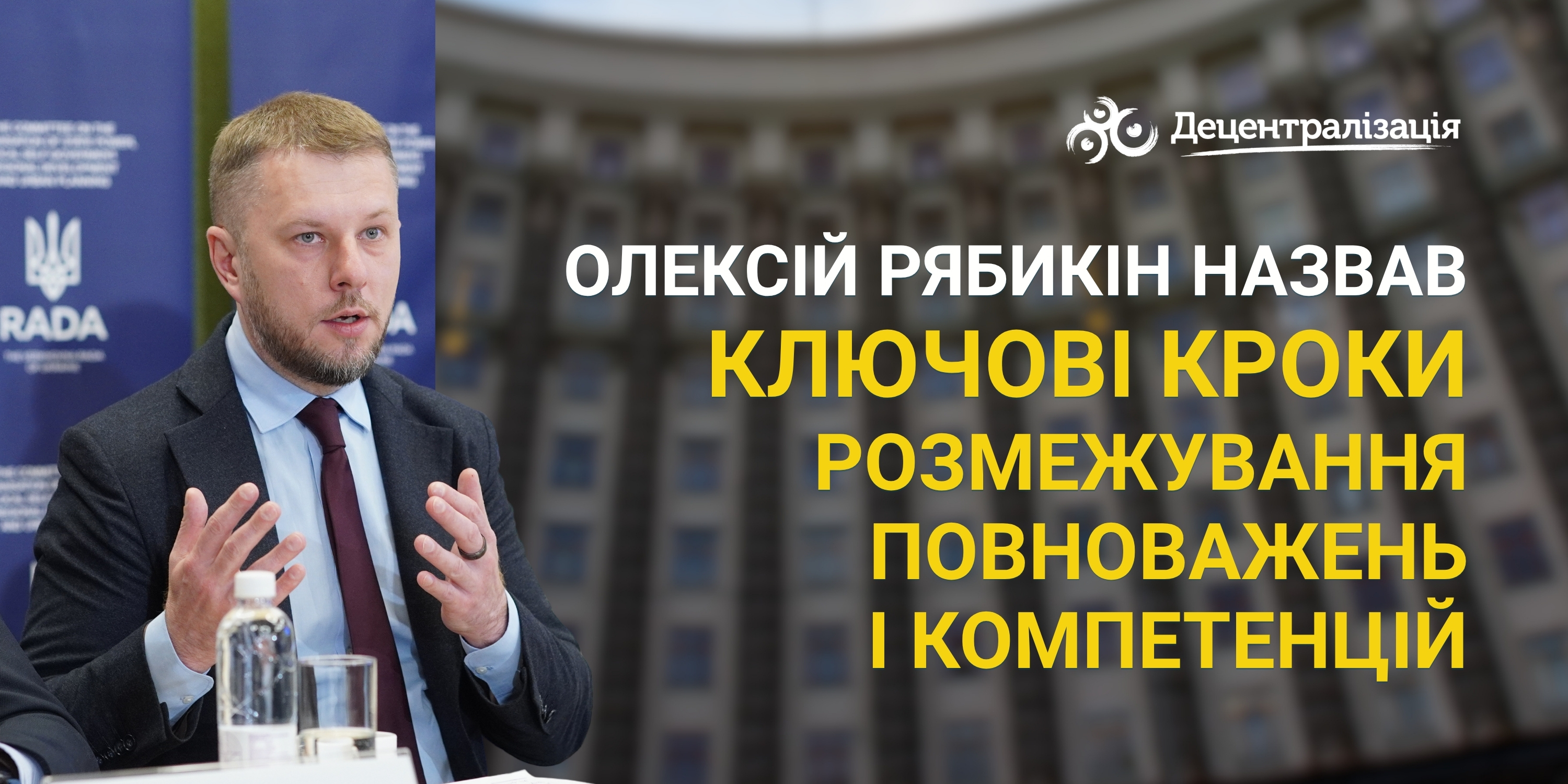
During the roundtable discussion ‘Principles of the delineation of powers between different levels of public authority in Ukraine’, organised by the Verkhovna Rada Committee on the Organisation of State Power, Local Self-Government, Regional Development and Urban Planning, Oleksii Riabykin, Deputy Minister for Development of Communities and Territories of Ukraine, outlined approaches to the next stage of the reform.
This is not only a legislative change but also part of the implementation of Step 9.3 of the Ukraine Plan, the realisation of which involves the mobilisation of EUR 440 million in international aid.
Oleksii Riabykin emphasised that Draft Law No. 14412, adopted at first reading, is a framework law and sets out the general principles for the delineation and distribution of powers between levels of public authority.
At the same time, the key next stage is the sectoral delineation of powers – that is, their practical distribution across specific areas of public policy.
According to him, the European Commission views the general direction of the reform positively, but emphasises precisely the importance of such sectoral delineation. To achieve this, Ukraine may be granted additional time – until the first quarter of 2027.
In a comment for the Decentralisation Portal, Oleksii Riabykin explained in detail that the reform actually consists of two interrelated legislative blocks.
The first one – Draft Law No. 14412 – defines the principles, conditions and criteria for the delineation of powers between:
- local self-government and executive authorities,
- different levels of local self-government.
The second one – a separate draft law on the delineation of areas of competence – is intended to establish exactly who is responsible for formulating and implementing policy in which areas at each level of local self-government:
- regional,
- district,
- basic (community).
This approach allows not only for the establishment of general rules, but also for the resolution of conflicts between levels of authority and the assurance of a clear delineation of functions.
According to the Deputy Minister, the draft law on the delineation of areas of competence proposes to assign powers according to a sectoral principle across 15 key areas.
These include education and science, healthcare, social policy, transport, the environment, security, defence, economic development, as well as veterans’ policy, which has been singled out in view of the challenges posed by the war.
This is intended to create a systemic model in which each level of local self-government has a clearly defined role in the relevant area of policy.
Oleksii Riabykin drew particular attention to the absence of a single definition of basic concepts in current legislation.
Despite their widespread use, the terms ‘powers’ and ‘sphere of competence’ lack a clear legislative interpretation.
As part of the preparation of legislative amendments, it has been proposed to distinguish between these concepts:
- powers – as the right and duty to act,
- sphere of competence – as the set of such powers in a specific area of policy.
This is necessary to standardise approaches and avoid ambiguities in the legislation.
The delineation of powers and competences covers provisions in over 300 laws and codes.
Therefore, according to Oleksii Riabykin, these draft laws are intended to serve as the foundation for a comprehensive ‘review’ of sectoral legislation within a year of their adoption.
Preparations for this stage are already underway: within the working group, nine sectoral sub-groups were established, which over several months developed proposals on key areas of public policy.
Among the main challenges, the Deputy Minister mentioned:
- the significant scope of powers that need to be delineated,
- different approaches to their division among governing bodies,
- the uncertainty of the role of the district level of local self-government.
The latter issue is particularly sensitive: the district level is retained in the Constitution, but its functional capacity has been significantly limited following decentralisation.
Prior to amending the Constitution, an approach is proposed whereby fully-fledged executive bodies are to be established at all levels, whilst some powers will be temporarily exercised by state administrations.
According to Oleksii Riabykin, the preliminary technical comments from the European Commission broadly confirm that the proposed approaches are in line with European standards and the principles of subsidiarity.
However, the EU recommends continuing the work, in particular regarding:
- the harmonisation of sectoral legislation,
- the clarification of the role of the district level,
- the definition of the role of local state administrations,
- the avoidance of duplication of powers,
- the strengthening of institutional capacity and the provision of resources.
In conclusion, Oleksii Riabykin emphasised: the delineation of powers and competences must yield practical results – improving the quality of services, enhancing people’s living conditions, and creating the conditions for the rapid and effective recovery of communities and regions.
Put simply, this is an attempt to ensure that the state no longer has any issues that are “nobody’s responsibility”.
Reference
The round-table discussion ‘Principles of the delineation of powers between different levels of public authority in Ukraine’ was organised by the Verkhovna Rada Committee on the Organisation of State Power, Local Self-Government, Regional Development and Urban Planning. The event was held in cooperation with the Ministry for Development of Communities and Territories of Ukraine, with the support of U-LEAD with Europe and the Centre of Expertise for Multilevel Governance at the Congress of Local and Regional Authorities of the Council of Europe.
30 April 2026
Ще понад 421 млн гривень отримають громади для...
25 закладів освіти отримають фінансування на придбання обладнання, створення та модернізацію харчоблоків. Уряд...
30 April 2026
Житомир і Херефорд стали містами-побратимами: нове партнерство з Великою Британією
Житомир і Херефорд стали містами-побратимами:...
Житомир розширює географію міжнародної співпраці — міська рада уклала Угоду про встановлення дружніх побратимських...
30 April 2026
На ІІ Міжнародному Форумі згуртованості...
29 квітня у Києві в межах ІІ Міжнародного Форуму згуртованості відбулася урочиста церемонія нагородження громад та...
30 April 2026
Робота в релокації: як Пологівська громада вибудовує партнерства та зберігає ідентичність
Робота в релокації: як Пологівська громада...
Цього разу - історія Наталії Копил, начальниці відділу енергоменеджменту, енергоефективності та інвестицій...