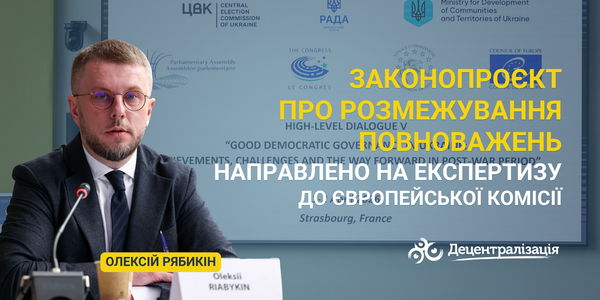
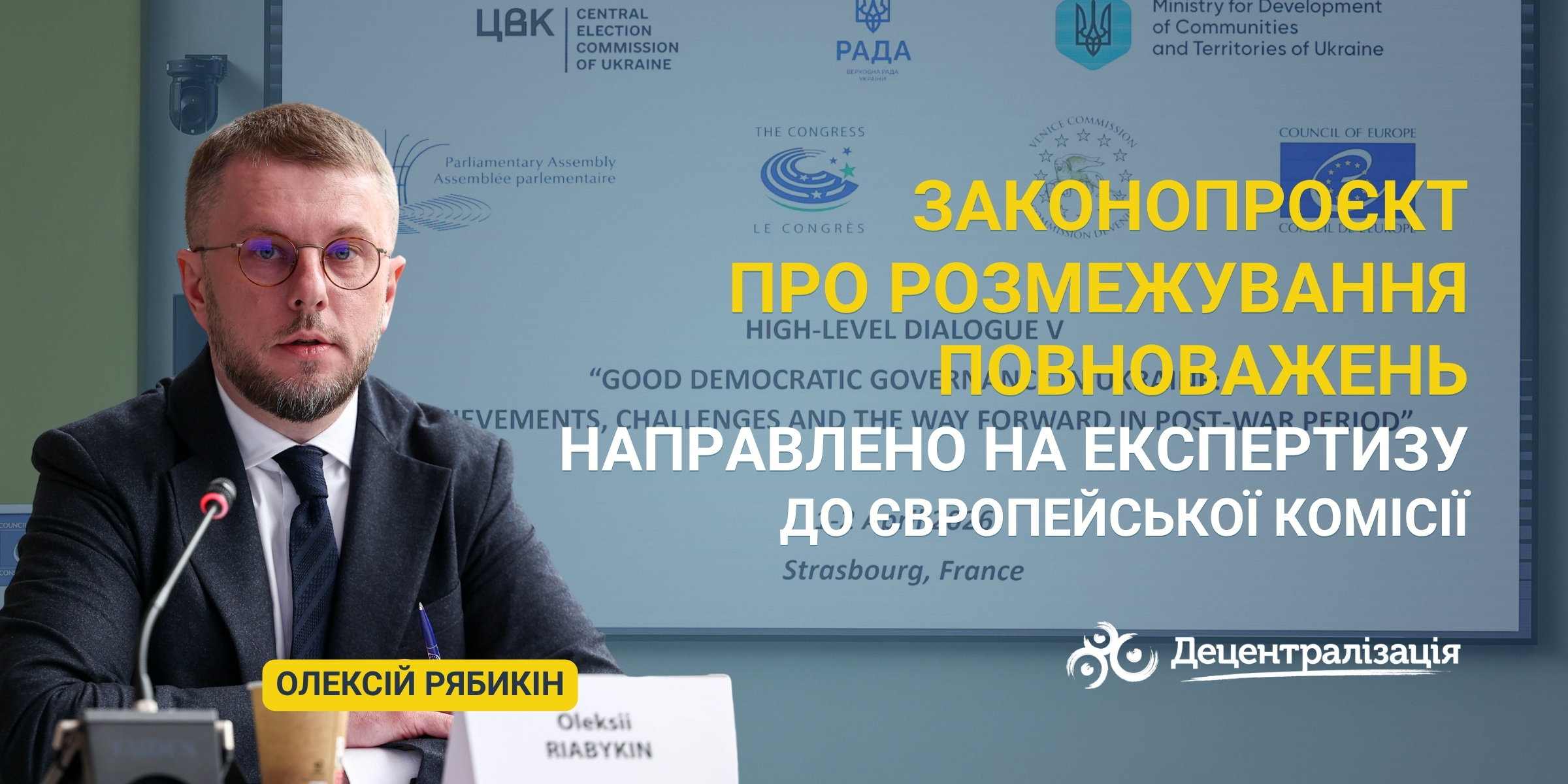
Oleksii Riabykin: Draft Law on Delineation of Powers Sent to the European Commission for Expertise
On 1 April 2026, in Strasbourg, as part of the High-Level Dialogue V “Good Democratic Governance in Ukraine: Achievements, Challenges and the Way Forward in the Post-War Period”, Oleksii Riabykin, Deputy Minister for Development of Communities and Territories of Ukraine, delivered a speech. During a panel discussion on the system of multi-level governance in Ukraine, the official outlined key legislative developments, challenges of fiscal decentralisation, and approaches to restoring authority in de-occupied territories.
One of the key messages of the speech was further progress in establishing a clear system for the distribution of powers between levels of public governance. Oleksii Riabykin recalled that on 30 January 2026, the Government submitted Draft Law No. 14412 “On the Principles of Delineation and Distribution of Powers between Levels of Public Governance” to the Verkhovna Rada, and on 26 February, the профиль committee recommended its adoption as a basis.
At the same time, according to the Deputy Minister, work on improving the system is ongoing.
“We are currently continuing to develop a draft law on the delineation of areas of competence between levels of local self-government. It aims to define key areas of competence at the respective levels in order to strengthen legal certainty and eliminate conflicts of competence. This draft law has been sent to the European Commission for expertise,” said Oleksii Riabykin.
He also drew attention to the significant resources allocated by the state to support de-occupied and affected territories — UAH 30.4 billion, directed to ensure the functioning of education, healthcare, social protection, and basic utility services.
A separate part of the speech focused on strengthening the financial autonomy of communities by revising approaches to the administration of local taxes and fees. Oleksii Riabykin noted that local self-government bodies currently have limited influence over these processes, which requires testing new models of interaction with the State Tax Service.
“The Ministry for Development has, on its own initiative, developed a draft Government act aimed at creating a basis for cooperation and interaction between the State Tax Service, its territorial bodies, and local self-government bodies. This is intended to implement a pilot project to create conditions for increasing revenues to the budgets of rural, settlement, and urban territorial communities as a result of local authorities performing certain functions in the administration of local taxes and fees,” he said.
In addition, the Deputy Minister emphasised the need to review the principle of personal income tax allocation.
“The issue of crediting personal income tax to the budgets of territorial communities based on the registered place of residence of the taxpayer is currently under consideration. In our view, this will significantly strengthen the financial capacity of subsidised rural communities, reduce imbalances in community revenues, and increase the accountability of local self-government bodies to residents for the effective use of funds,” noted Oleksii Riabykin.
An important part of the speech addressed the restoration of local self-government in de-occupied and frontline territories. Oleksii Riabykin stressed that the key barrier remains the security factor, and the transition from military administrations to civilian authorities must be gradual and regulated by law.
Speaking about temporarily occupied territories, Oleksii Riabykin emphasised that their return cannot be a mere technical resumption of the work of authorities. Over the years of occupation, there has been a deep deinstitutionalisation of public administration.
“This involves a comprehensive reboot of the governance system, which must simultaneously ensure security, restore the legal framework, relaunch institutions, rebuild trust, and ensure the gradual cognitive reintegration of the population,” the Deputy Minister stressed.
He also reported that the Ministry for Development has developed a number of documents for systematic preparation for de-occupation, including a draft resolution of the Cabinet of Ministers of Ukraine defining the priorities of state policy regarding temporarily occupied territories, and has begun drafting an act to approve the conceptual framework for transitional justice in Ukraine.
The second day of the High-Level Dialogue, to be held on 2 April, will focus on the organisation and conduct of safe democratic elections in the post-war period. Participants will address legal regulation of the electoral process, security challenges, as well as mechanisms to counter disinformation and foreign interference.
Source:
Портал "Децентралізація"
02 April 2026
Громади підключать 100 МВт когенераційних установок за кошти держбюджету
Громади підключать 100 МВт когенераційних...
Громади приєднають до мережі 75 вже наявних когенераційних установок загальною електричною потужністю майже...
02 April 2026
Квітневі каталоги можливостей: підтримка громад та бізнесу
Квітневі каталоги можливостей: підтримка громад...
Великодні свята – час не лише для відпочинку, а й для розвитку. В цьому громадам допоможуть нові Каталоги...
02 April 2026
Громади зможуть отримувати пряме фінансування...
Територіальні громади України незабаром зможуть залучати кошти польського державного банку розвитку BGK безпосередньо...
02 April 2026
Децентралізація – найголовніше за березень
Децентралізація – найголовніше за березень
На початку кожного місяця портал «Децентралізація» підбиває підсумки рішень Уряду та Парламенту, що стосуються...