Tax administration by communities: Ministry for Development to launch experiment
The Ministry for Development of Communities and Territories has initiated a pilot project that will allow communities to voluntarily participate in the administration of selected local taxes and fees. The relevant Government Draft Act has already been sent for approval to all-Ukrainian associations of local governments, key stakeholders, and ministries.
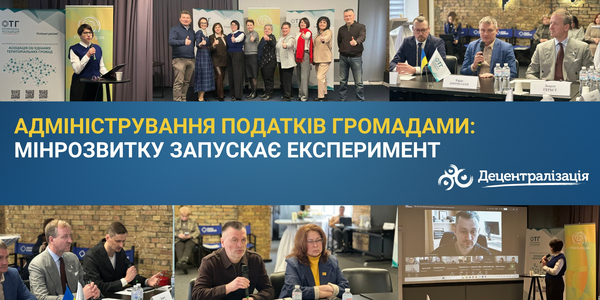
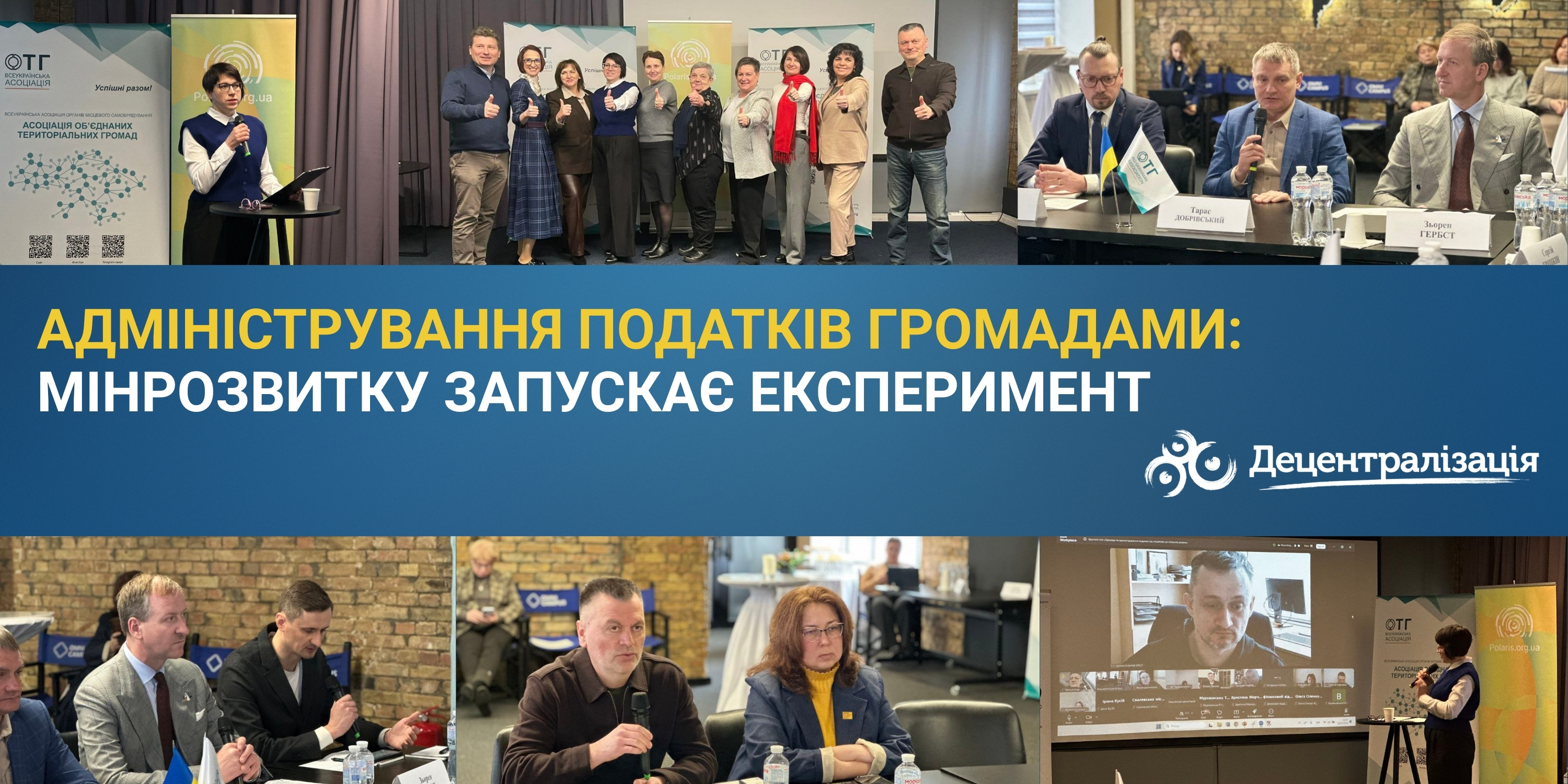
The experiment was one of the key topics for professional discussion at the round table ‘Communities and Tax Administration: From Initiative to Joint Decisions’, which was held at the premises of the All-Ukrainian Association of Amalgamated Territorial Communities. Organised with the support of the Polaris Programme ‘Supporting Multilevel Governance in Ukraine’ and the assistance of the U-LEAD with Europe Programme, the event brought together more than 500 participants from across the country, who joined the discussion in a mixed format.
Experiment of the Ministry for Development: ‘window of opportunity’ for communities
Presenting the concept of the pilot project, Mykola Rubchak, Director of the Department of Multi-Level Governance at the Ministry for Development, emphasised that participation of communities would be entirely voluntary, and interaction between local governments, the State Tax Service and the central government would be formalised through relevant agreements. The experiment aims to test the readiness of communities to take a more active role in tax administration without changing the basic status of tax authorities.
According to Mykola Rubchak, a preliminary list of communities eligible to participate in the experiment has already been drawn up. He also emphasised that other communities wishing to join the project can exercise this right through the All-Ukrainian Association of Amalgamated Territorial Communities, which has the authority to officially submit proposals to expand the circle of participants.
Round table as a space for systematic dialogue
The initiative of the Ministry for Development was a logical continuation of the long-term work that the Association has been doing together with experts and government bodies. In his welcoming speech, Taras Dobrivskyi, Executive Director of the All-Ukrainian Association of Amalgamated Territorial Communities, emphasised that the issue of tax administration today goes far beyond the fiscal sphere:
‘In particular, it also concerns security issues, as communities need to increase resources at the local level in order to perform their duties effectively. I strongly hope that through joint efforts, we will be able to move closer to resolving issues that concern communities and replenish their budgets,’ he said, expressing his gratitude to the Polaris and U-LEAD Programmes for their support.
Oleksandr Mazurkin, Program Manager at Polaris, emphasised that effective administration of local taxes is not only a technical task, but also the key to transparency, fairness, and the ability of communities to provide quality services. Meanwhile, Sören Herbst, Head of the Multi-Level Governance Unit at U-LEAD with Europe, noted the importance of involving all stakeholders in the dialogue, from communities to central authorities.
U-LEAD research: Capability depends on leadership, not size
One of the key topics discussed at the roundtable was the presentation of the results of a survey of local financial authorities, which was conducted by U-LEAD with Europe experts. A total of 418 local government representatives were surveyed, ensuring a high level of data representativeness.
The main conclusion of the study refutes the established stereotypes: the decisive criterion for the ability to administer local taxes is not the type of community or the amount of available resources, but the level of leadership and initiative at the local level. This creates equal opportunities for small communities, putting them on a par with regional centres.
However, 90 per cent of respondents noted that they would require additional financial resources to perform their new functions fully. Regarding the administration model, the majority favoured a joint format of work between local governments and the State Tax Service, although 27.5 per cent of respondents believe that this function should remain the exclusive competence of the tax service.
Developments made by Polaris: ‘soft model’ of community participation
Ihor Herasymchuk, Polaris Program Expert, presented a systematic vision for expanding the role of local governments – from conceptual approaches to specific legislative changes. He presented the findings of a joint working group created by the All-Ukrainian Association of Amalgamated Territorial Communities, which included community representatives, Polaris experts, and relevant specialists.
The key focus is on the so-called ‘soft model’ of participation, which provides for:
- preservation of the controlling functions of the State Tax Service;
- strengthening the role of communities in the verification of data, work with registers, analytics, and communication with taxpayers;
- use of the mechanisms of inter-municipal cooperation for small communities;
- digitisation of processes and integration with state registers.
According to experts, the implementation of these approaches could increase local budget revenues by 15–30 per cent through data updating, de-shadowing of facilities and effective work with debtors.
Legislative framework and the position of communities
Ukrainian MP Vitalii Bezgin, who together with Ihor Marchuk initiated the setting up of a working group under the Ukrainian Parliament, outlined six key principles of the future draft law:
- Administration is a right, not an obligation, of communities.
- Improvement of information exchange.
- Digitisation of processes and tax notices-decisions.
- Local tax relief – the exclusive right of local governments.
- Start with property taxes.
- Support for inter-municipal cooperation.
Voice of communities: Administration is already de facto, now time for de jure
Vasyl Koval, Head of the Local Budgets and Finance Platform of the All-Ukrainian Association of Amalgamated Territorial Communities and Head of the Pidberiztsi Village Council, presented the position of practitioners. Referring to the experience of Pidberiztsi community, which has been demonstrating successful cases in local resource management for several years, he emphasised the importance of strengthening the role of communities in the administration of local taxes and fees. Among other things, the speaker emphasised the need to legislate the right of local governments to go to court to collect land tax and property tax arrears.
‘Nowadays, local governments are already involved in managing local taxes and fees. Taxpayers who live in communities come to us first to figure out different tax issues. Accordingly, we are already involved in these processes and often provide organisational support for them,’ said Vasyl Koval. ‘For example, an inventory of land plots was carried out in Pidberiztsi community, resulting in their number increasing from five to over 12,000. The situation is similar with property tax – there has been an increase in the base of more than 30 per cent, especially for commercial real estate. This is a resource that we are now directing towards the defence capability of the state and social support for our residents.’
According to the community leader, there is an urgent need to legislate the functions of local tax administration by local governments as a full-fledged party to the process, on a par with the State Tax Service. He outlined the key issues that are of concern to communities: how to bring the service closer to residents and reduce the time it takes to provide it? How to stimulate an increase in revenue? How to organise the work of employees when serving taxpayers? How to achieve synergy between the interests of taxpayers, the State Tax Service and local governments?
Meanwhile, Vasyl Koval stressed that the people behind the reform know that transferring administrative functions will put extra pressure on local governments, and not all of them will have the staff and resources to make the changes happen. As one way to overcome these difficulties, he suggested considering a model of inter-municipal cooperation – the creation of joint inter-municipal departments would allow communities to join forces to ensure high-quality control over the completeness of tax payments at the local level.
Representatives of the Ministry of Finance, the Ministry of Digital Transformation, and community financiers from various regions of Ukraine also joined the discussion. A separate outcome of the event was the work of a focus group facilitated by Tetiana Arseniuk and Ihor Herasymchuk, where community representatives developed specific recommendations for further advocacy.
Reference. The All-Ukrainian Association of Amalgamated Territorial Communities continues to collect proposals from communities wishing to join the experimental project of the Ministry for Development and systematises the findings of focus groups for submission to legislative and executive authorities.
Source:
Портал "Децентралізація"
04 March 2026
Львівська агломерація і Метрополія Ґетеборгу (Швеція) заклали основу для довгострокового партнерства
Львівська агломерація і Метрополія Ґетеборгу...
Перспектива розвитку метрополій, які у нас більш звично називати агломераціями, останнім часом привертає до себе все...
04 March 2026
Кращі практики на старті: як Центри...
Старт нових сервісів психосоціальної підтримки в умовах війни завжди є викликом. Обмежені ресурси, інфраструктурні...
04 March 2026
Helvetas проводить відбір ТГ Харківської області для забезпечення мешканців житлом
Helvetas проводить відбір ТГ Харківської...
В межах проєкту «Horizon Homes: сталий модульний житловий проєкт в Україні», що впроваджується швейцарською...
04 March 2026
Снігурівська МВА підписала першу угоду про партнерство з данським муніципалітетом Гентофте
Снігурівська МВА підписала першу угоду про...
Снігурівська міська територіальна громада розпочинає новий етап міжнародної співпраці. Начальник Снігурівської...