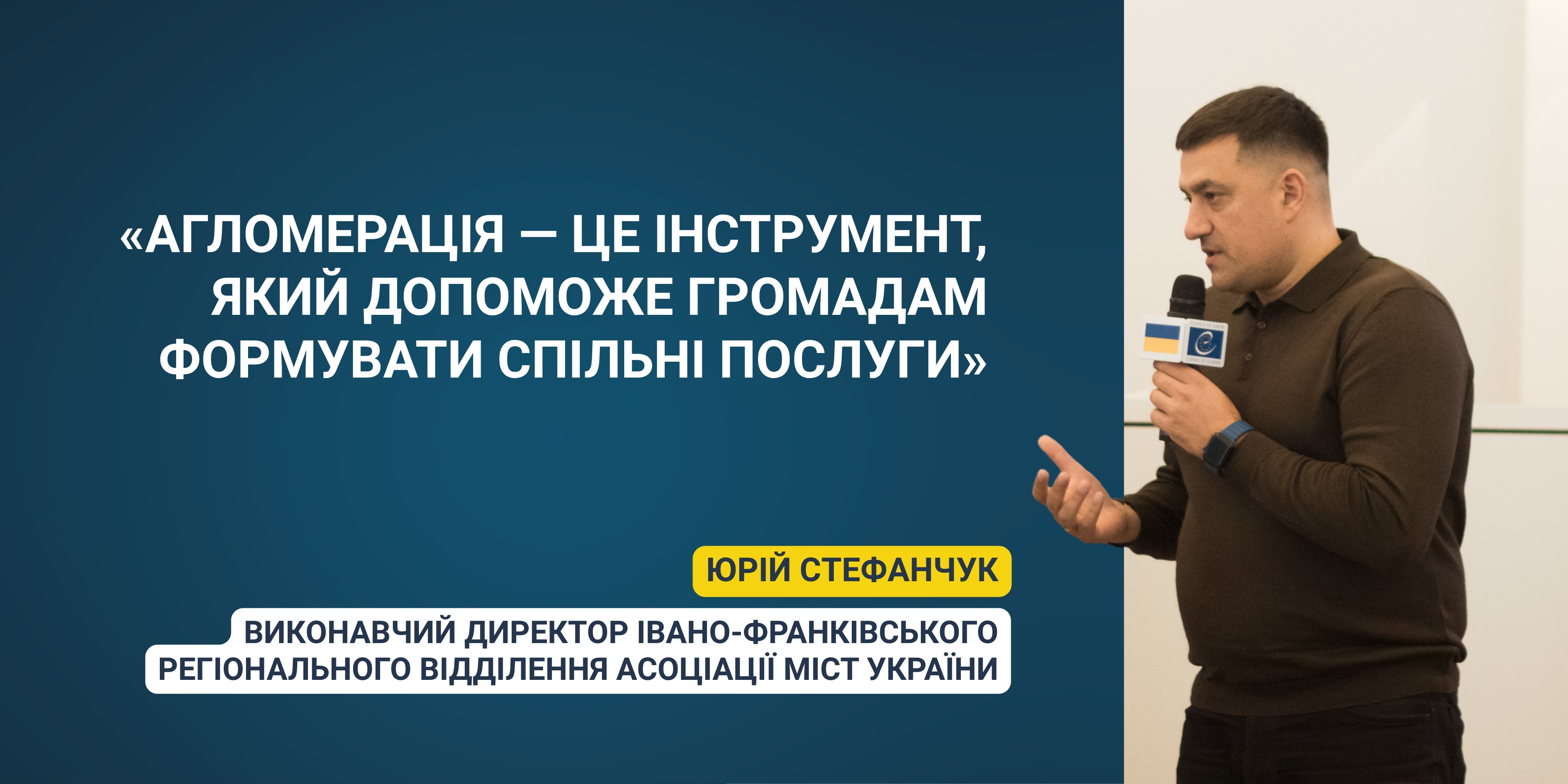
‘Agglomeration is a tool that will help communities develop shared services.’
Interview with Yurii Stefanchuk, Executive Director of the Ivano-Frankivsk Regional Office of the Association of Ukrainian Cities
(Recorded during the II International Forum of Ukrainian Agglomerations, ‘Agglomerations and Functional Territories: European Approaches and Their Implementation in Ukraine’, Lviv, 24 October 2025).
– Mr Stefanchuk, why is the topic of agglomerations important for the Ivano-Frankivsk region?
– Speaking of agglomeration, we mean the joint efforts of communities to solve common problems that everyone faces today, such as transport, waste management, social services and infrastructure.
People from surrounding communities come to Ivano-Frankivsk every day for work, hospital appointments, and school. Therefore, it is important to ensure that these processes are convenient for the city and neighbouring communities alike.
Agglomeration is one of the tools that enables communities to pool their resources and plan their development collectively, rather than individually.
– In your opinion, are the communities in the Ivano-Frankivsk region ready to cooperate through agglomeration?
– We have actively begun this work. Over a hundred leaders of territorial communities are participating in the development of agglomeration approaches. We are reviewing the development strategies of each community. Notably, the recently approved Ivano-Frankivsk Development Strategy includes a section on the use of agglomeration tools.
Next, we will move on to developing the strategic documents and policies that will underpin the practical work of the agglomeration.
– What might the roadmap for establishing the Ivano-Frankivsk agglomeration entail?
– In the near future, we need to develop a concept for the activities of the agglomeration. Next, we need to develop strategic documents that define the main areas of work. After that, we need to decide on an organisational model, such as an association or a public organisation. We are currently discussing this.
We also plan to seek opportunities for our communities to participate in international projects, uniting them around specific issues.
One of our key areas of focus is transport. Every day, people from surrounding communities travel to Ivano-Frankivsk. Therefore, we need to decide how to provide them with convenient, systematic transport. At the same time, we need to reduce traffic in the city itself. This will probably be the first area we work on.
– You have just returned from a visit to the Lviv agglomeration. What are your impressions?
– I was most impressed by the level of communication. We realised that it is important to establish a dialogue system in which communities can openly discuss the challenges they face.
We have experience in creating amalgamated territorial communities, and we recall how crucial it was for the process to be voluntary. The same applies here: communities must recognise the benefits for themselves and actively engage in agglomeration cooperation. When they analyse problems together, they develop a clear idea of where to start and how to proceed.
– Are you studying the experience of other regions of Ukraine that have already formed agglomerations?
– Yes. We are observing the development of the Kyiv agglomeration, and we can see that Lviv has also achieved a great deal in this area. This is a good example for us to follow. We can learn from their experience and adapt it to our own situation, avoiding other regions’ mistakes.
– Finally, what do you consider to be the most significant outcome of the agglomeration’s work?
– As I have said before, the most important thing is good communication between communities. If there is communication, there will always be results. Creating a platform where communities can discuss, consult, and resolve various issues related to transport, waste, social services, and more will be a significant step forward.
Agglomeration is not about form; it is about content. It is about cooperation. Moving together in the same direction is development.
This material was produced within the Council of Europe Action Plan for Ukraine ‘Resilience, Recovery and Reconstruction’ for 2023–2026 and the project ‘Strengthening multilevel governance and local democracy to support Ukraine’s recovery’, implemented by the Centre of Expertise for Multilevel Governance at the Congress of Local and Regional Authorities of the Council of Europe.

Tags:
Область:
Івано-Франківська областьSource:
Програма Ради Європи
22 October 2026
Олена Шуляк: громадам потрібно спільно...
Війна, внутрішня міграція та масштабна відбудова загострили питання, які не вкладаються в межі однієї громади. Про це...
22 October 2026
Віталій Безгін: агломераціям потрібні зміни до секторального законодавства
Віталій Безгін: агломераціям потрібні зміни до...
У Львові розпочався III Міжнародний форум агломерацій в Україні «Співпраця громад у функціональних територіях». У...
22 October 2026
У Львові розпочався III Міжнародний форум агломерацій в Україні (наживо)
У Львові розпочався III Міжнародний форум...
У Львові розпочався III Міжнародний форум агломерацій в Україні «Співпраця громад у функціональних...
22 October 2026
Уряд розподілив кошти на житло для ВПО та спростив облаштування посилених укриттів
Уряд розподілив кошти на житло для ВПО та...
На забезпечення переселенців житлом у сільській місцевості розподілено 26,5 млн грн між вісьмома обласними бюджетами....